
I rode down to London on a proper scorcher, 29 degrees by the time I hit the city. Scenic plotted the route out of Harpenden, through St Albans, Chipping Barnet, and Edgware, avoiding the motorway the whole way down into the City of London. Twenty-six miles, just over an hour on the road. The closer I got, the more London opened up ahead of me, that first proper skyline view still catches you off guard no matter how many times you’ve seen it, glass and steel rising out of the haze, a city built for cars, where free motorcycle parking is disappearing borough by borough, Camden being the latest to fall in line.
I found my parking options using the London Bike Bays app, a free tool that started life in 2020 as a prototype web map before growing into what it now calls the most detailed motorcycle parking resource in London, over 100,000 riders using it, according to the site itself. A paid subscription, under a fiver for the whole year, unlocks search by road name and lets you copy a bay’s exact coordinates straight into route-planning apps like Scenic, which is genuinely useful. It threw up two choices nearby: Balfe Street and Chalton Street. I went with Chalton Street, £1.30 for the day, paid without any fuss. A small, practical tool like this says something on its own, in a city where finding a legal bay can be as much of a challenge as affording one, an independent app built by riders has quietly become more useful than anything the boroughs themselves provide.
I was here to meet the team behind Gramos Coffee, a real interview, full writeup coming soon on the site. From Chalton Street it took about five minutes to reach St Pancras on foot, past St Pancras Gardens, a genuinely lovely pocket of green tucked away from the road, then a skate shop, then straight into the heaving crowds of the station itself, people heading every which way, none of them in any particular hurry to make room for a rider in full gear cutting through.
Since 10 February, parking a motorcycle on the street in Camden hasn’t been free anymore. Riders without a valid permit now pay to use a solo motorcycle bay, £1.30 a day for a standard bike, 66p for electric models, Camden’s own explanation being that the lower electric rate is there “to encourage cleaner travel.” It’s a modest sum on paper. But it marks the end of something London riders have taken for granted for years: free, unrestricted motorcycle parking across an entire inner-London borough.
For an area long known among riders as one of the last easy places to leave a bike near King’s Cross and St Pancras, that matters. And the story of how Camden got here, and where the charges might still go, is more complicated than a headline figure suggests.
How we got here
Camden’s plans didn’t start at £1.30 a day. They started much higher. Save London Motorcycling (SLM), the independent campaign group that’s fought this policy since 2020, says the council’s original proposal was £6 an hour, with all-day parking banned outright. Had that gone ahead unchallenged, a full day’s parking would have cost riders more than £30, several times what a car pays for the equivalent.
Years of sustained campaigning, petitions, council deputations, formal consultation responses, brought that down substantially. The £1.30 daily rate that took effect in February is set to rise to £2.60 next year. Ben, who leads Save London Motorcycling’s work on this, is clear that this counts as a real win relative to where things started, even if the group still considers the underlying approach flawed.
“The core problem with Camden’s policy is the starting point,” he told me, “assuming that car parking policy can simply be applied to motorcycles.” His argument is straightforward: motorcycles aren’t small cars, and treating them like scaled-down versions of the same problem misses basic physical reality. Around eight motorcycles fit in the kerb space one car requires. They don’t contribute to congestion the way cars do. Their environmental footprint is different too. A policy that starts by assuming otherwise, he argues, was always going to produce the wrong answer.
The specifics that still rankle
Even after years of the charges being watered down, several details remain that SLM considers holdovers from car-first thinking rather than anything designed specifically around how motorcycles are actually used.
Residents’ permits for motorcycles are charged at the same rate as the smallest cars. A resident who owns both a car and a motorcycle isn’t allowed to hold two permits, even though the vehicles serve entirely different purposes and take up very different amounts of space. And there’s no discounted annual block-booking product for visitors or commuters. Someone commuting daily into Westminster can buy an annual pass for around £100. The equivalent cost in Camden, paying the daily rate every working day, works out closer to £600 a year.
Perhaps the detail that draws the sharpest criticism is that Camden charges electric motorcycles at all. Ben doesn’t hold back here: “Clearly electric motorcycles have no more impact than a Lime bike, yet Camden is seeking to discourage them without any real justification whatsoever.” Given the policy’s own stated aim is reducing emissions and encouraging cleaner transport, charging a zero-emission vehicle, even at a discount, sits awkwardly next to that goal.
What Camden says
Camden’s public position is rooted less in motorcycle-specific reasoning and more in a borough-wide transport strategy. The Camden Transport Strategy sets out a broader objective: reducing what it calls “inessential motor vehicle ownership and use,” encouraging cleaner and more sustainable travel, and freeing up road space for those who need it most. Motorcycle parking charges sit inside that wider framework rather than as a standalone policy built specifically around how bikes are used.
Councillor Adam Harrison, Camden’s Cabinet Member for a Sustainable Camden and the politician who has led on this policy throughout its development, has defended the approach at various points as it evolved. Speaking to a council meeting in 2021, during the consultation period for an earlier, harsher version of the plans, he noted the process had drawn 573 responses, “a healthy response figure, especially during a pandemic,” and pushed back on suggestions that the council’s equalities impact assessment had ignored the policy’s negative effects. He’s also previously argued that even the higher charges once proposed remained well below equivalent car parking costs, and so were unlikely to push riders into buying cars instead.
It’s worth being clear about timing here: those particular comments date from 2021, during an earlier and more punitive version of the proposals, rather than being fresh responses to the charges as they now stand. Camden was approached for comment on the current scheme for this piece but hadn’t responded by publication.
How Camden compares to the rest of London
Camden isn’t the first London borough to introduce motorcycle charges, and according to Ben, it’s now something of an outlier among those that have. Most London boroughs still let motorcycles park for free. Westminster has charged for years, at £1 a day with discounted longer-term passes available, something Camden still lacks. Islington introduced a similar system after early rider pushback softened an initially harsher plan. Kensington and Chelsea proposed charges roughly double Westminster’s rate, but negotiation secured free parking in around half the borough’s motorcycle bays regardless.
Lewisham’s story follows a similar arc: an initial plan to charge motorcycles at car-equivalent rates was scaled back after early engagement with riders, landing at around £2 a day for visitors, free permits for electric motorcycles, and broader parking rights attached to a single daily session.
Hackney is the case Ben returns to most. The borough’s original proposal would have applied car parking rules directly to motorcycles, extremely high costs and maximum-stay restrictions that would have effectively banned commuting by bike in many areas. Petitions and public deputations made little difference. It took a legal challenge, backed by riders, before the council agreed to substantially reduce the charges, introduce monthly and annual discounts, halve resident permit rates, and make zero-emission motorcycles free to park.
Set against that pattern, Camden’s current position looks unusual in a specific way: daily charges with no meaningful block-booking option, and continued charging of electric motorcycles, at a point where most other boroughs that tried a harder line have since backed away from at least one of those two things.
What riders can actually do
Ben’s advice for anyone who wants to push back isn’t really about grand gestures. It’s about the slow, unglamorous work that’s already moved Camden’s numbers down twice. Contacting ward councillors directly, explaining specifically how the policy affects a real journey, a shift worker crossing the city before public transport starts running, a tradesperson who needs to carry tools, a resident using a motorcycle instead of running a second car, tends to carry more weight than general objection.
Responding to formal consultations matters too, even when a decision looks effectively settled. Ben is clear that formal objections become part of the public and legal record, which matters if things ever escalate toward the kind of legal challenge that eventually moved Hackney’s position. Joining Save London Motorcycling’s mailing list, sharing campaign material, and turning up when boroughs propose new anti-motorcycle measures all feed into the same pattern SLM has seen work before: councils find it easy to disregard isolated complaints, and much harder to ignore riders acting together with evidence behind them.
As Ben put it: “Motorcycles are a solution to London’s transport problems, not a problem to be solved.” Whether Camden comes to share that framing over time, or whether the current charges are simply where things settle, is likely to depend on exactly the kind of sustained, unglamorous pressure that got the price down from £6 an hour to £1.30 a day in the first place.
On the ride back, weaving through gaps in the traffic, blending in the way you learn to after enough years on London’s roads, I found myself thinking about how much has actually changed since I last rode these streets regularly. Technology has moved on: apps like London Bike Bays now save a genuine amount of time and fuel that used to go into just hunting for a space. Bikes have moved on too, mine included, efficient enough that it’s exempt from both the congestion charge and ULEZ. Set against all of that, Camden’s approach feels like it’s pulling in the opposite direction, still treating motorcycles like small cars, still adding friction for exactly the kind of rider it should be encouraging into town. I’ve tried to give both sides a fair hearing here. But by the end of it, I’ll admit, I’m struggling to follow the council’s own logic.
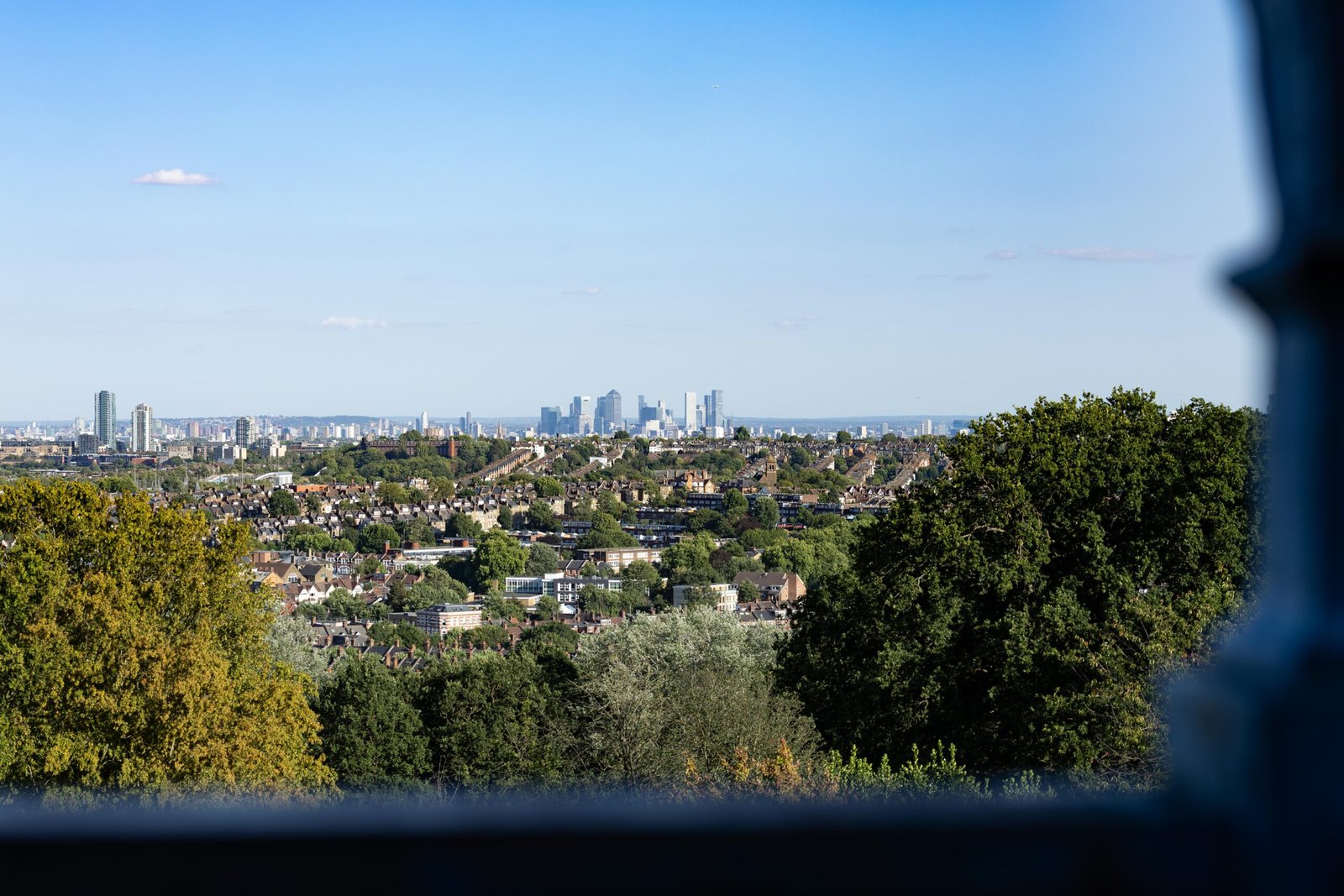
I asked Scenic for one last detour before heading home, up to Alexandra Palace, for a second skyline. Different angle, same city, glass and steel again, this time behind me rather than ahead, the evening light doing something the morning haze hadn’t. Two views of London in one day, arriving and leaving, and somewhere between them, a city that’s quietly made it a little harder, for reasons that still don’t quite add up, to ride in on a motorcycle.