

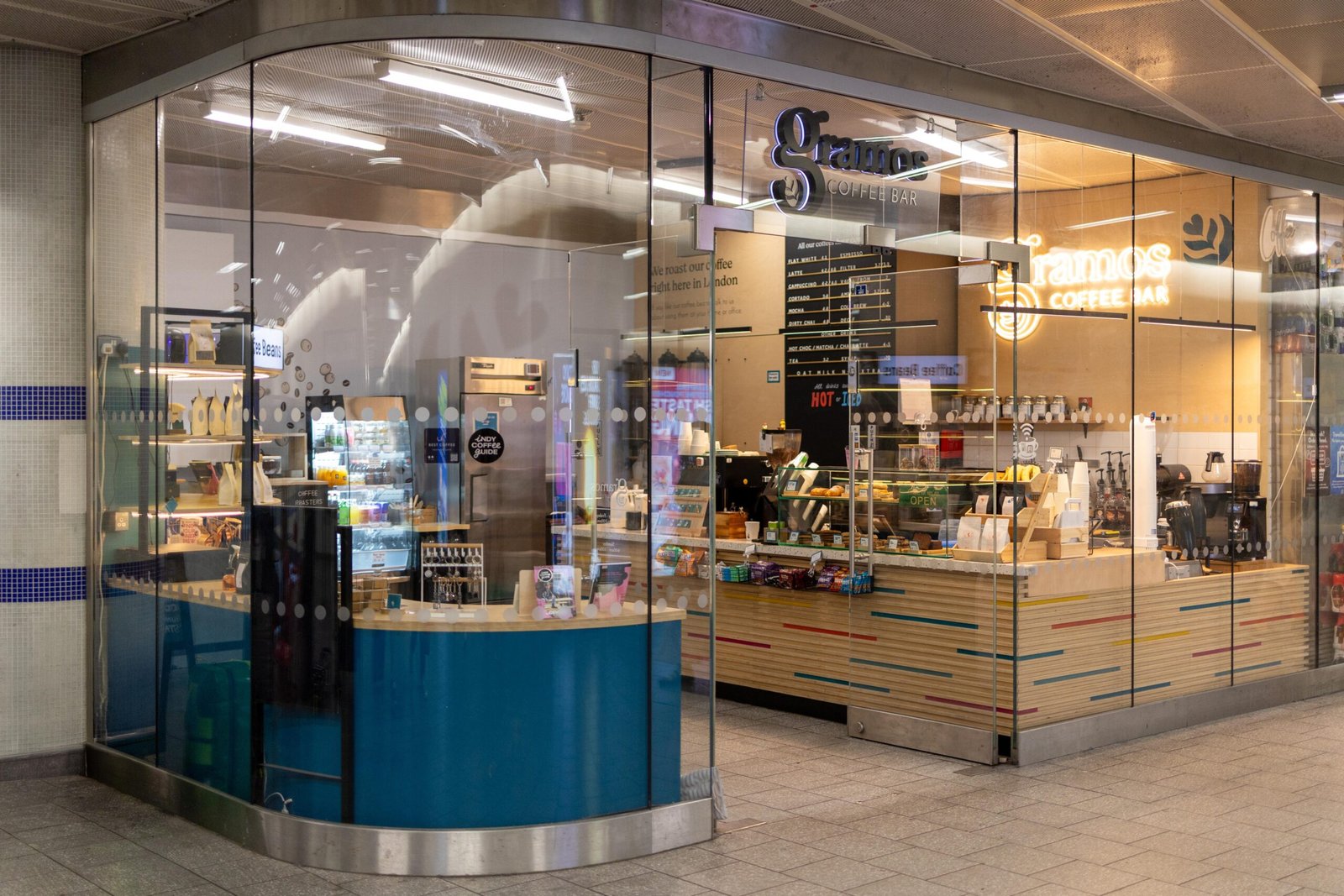
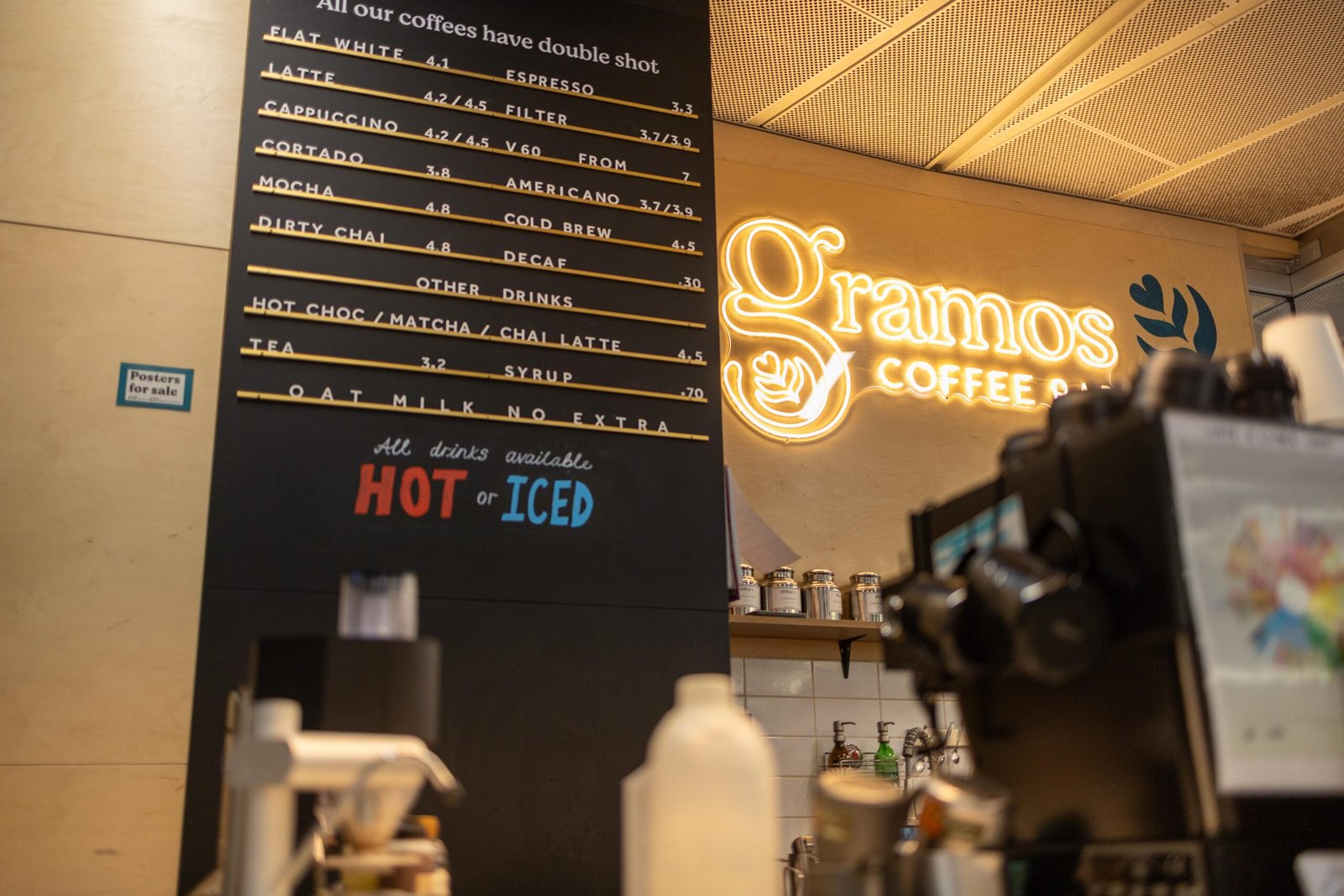
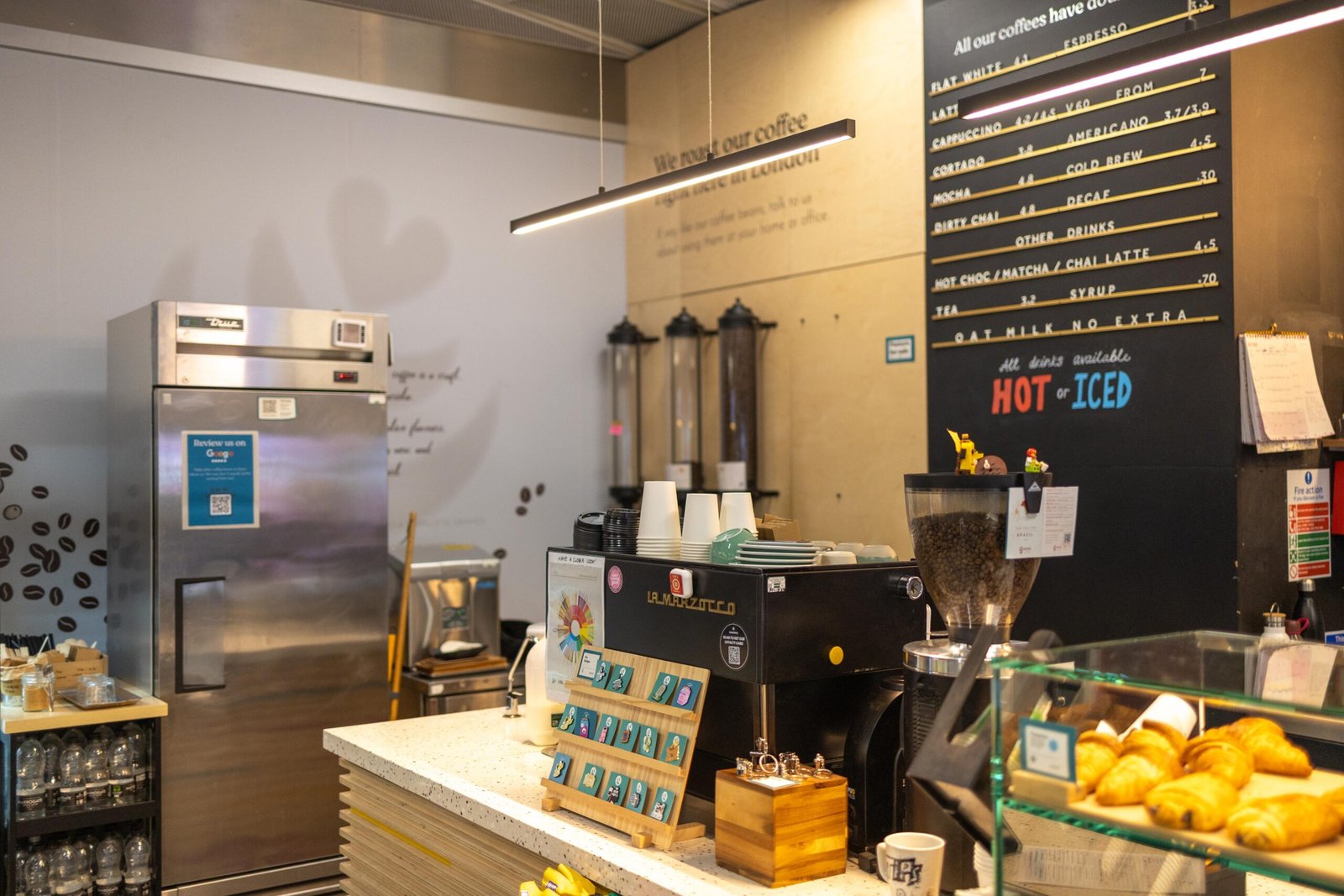
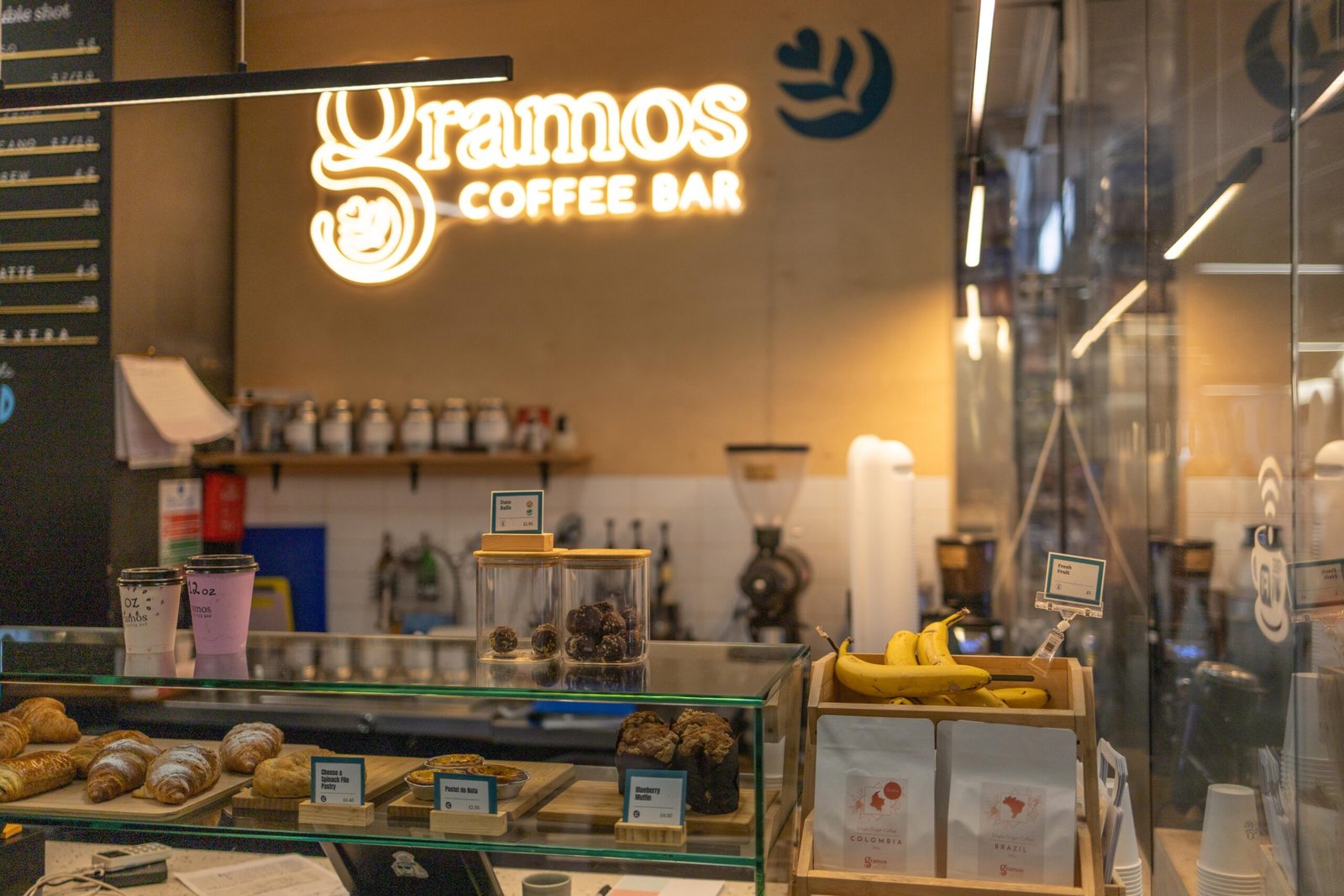
One level down at King’s Cross, Gramos Coffee Bar has been quietly building a following for ten years, an independent, single-origin coffee company that roasts its own beans on-site. Rated 4.9 stars on Google, and routinely described by regulars as a hidden gem, it’s easy to miss unless you already know it’s there. I’d taken a new route in this time, passing a few bits of London I’d never really looked at before, warm going on hot by the time I got there, 33 degrees and rising. I slotted into a space at Chalton Street nearby, and sat down with co-owner Charlotte for a coffee, wanting to know how it all began and what it’s really like running a shop in one of London’s busiest stations. Straight away, she told me there was never really a plan.
How Gramos Started
“I would love to say that we had a business strategy and an excellent plan and we knew exactly what we were doing,” she told me. “But the reality is, that I met Rodolfo, and we were dating for two years before this all started.” Rodolfo, originally from Bolivia, had been working in UK hospitality since he arrived, coffee houses, Starbucks, Pret, before landing a job running a specialty coffee pop-up in another train station entirely, Old Street. That’s where it clicked. Not just that he enjoyed the coffee, but that there was a science to it, grind size, settings, the way small technical decisions changed the flavour in the cup. Given his background as someone quite technical, that combination hooked him fast.
Three months into that job, he turned to Charlotte and said he wanted to try it himself. “We literally were like, okay, well, let’s get a credit card, let’s buy a coffee machine,” she said. Pop-up spaces were easy to rent short-term at the time, so that became the plan, if you could call it that. Charlotte, working full-time in the charity sector, offered to take a week off to help him set up.
“By the end of that week, I was like, oh my God, I run a business.” Someone had to handle marketing, invoices, ordering, telling people who they even were. Rodolfo could make the coffee. Everything else needed doing too, and Charlotte was suddenly doing it. “We were both in,” she said, “but we didn’t really know what we were getting into at all.”
Gramos means grams in Spanish, a nod to precision, and to Rodolfo’s heritage. Charlotte’s honest about how long it took for the name to actually mean something, though. “Understanding what our brand stood for has been a journey throughout the ten years, and it’s still ongoing now,” she said. “The original thought and concept around Gramos was because specialty coffee was about precision, attention to detail, complete care over it. So we looked at grams as the unit of measurement of coffee, and went for that.”
Charlotte and Rodolfo are partners in business and in life, and they’ve got a daughter too. I asked how that works day to day, whether there are unwritten rules for keeping the two separate.
“We have very different skill sets, and I think that’s why it works so well,” she said. “We do not go into each other’s territory. I don’t make coffee, I don’t roast, I don’t have that kind of technical understanding that he does. I leave that all to him. He doesn’t like Excel spreadsheets, he doesn’t like all the organisation.” She was a product manager by trade before Gramos, and it shows, she’s the one who takes Rodolfo’s ideas and puts them into practice. “It’s very rare that we ever disagree about direction, because we’re not stepping on each other’s toes.”
She doesn’t try to separate the business from the relationship either. “We are building a life together with this business. I often compare raising a child and raising a business as very similar things. It doesn’t feel like work, because you’re pushing for something, creating something that will sustain your lifestyle, your future, leave a legacy, whatever.” When she’s with Rodolfo, work doesn’t feel like a topic to avoid over dinner. “It’s more exciting than that. It’s like, what do you want to do with the business? Where do you want to go?”
The King’s Cross Chapter
Before King’s Cross, Gramos operated inside an office building serving international students, for about a year and a half. Good, steady, five days a week, right up until the pandemic hit and the building shut its doors. “The guy at the time said, you might as well take your stuff and go, we’re not opening.” But they were in a decent position, no debt, equipment paid off outright. So they sat with the question: what’s next?
Rodolfo used the enforced downtime to learn to roast. Up to that point, Gramos had been using other people’s beans, Caravan, Origin, others. “He was like, well, I’ve got a year sitting around,” Charlotte said. He bought a roaster and taught himself, wanting more ownership over the supply chain rather than relying on someone else’s work entirely.
Around the same time, a space came up in King’s Cross station. Charlotte’s account of landing it is almost dismissive of her own effort. “It was a Friday afternoon. I was like, okay, I’m just going to get this pitch in just so that it’s done. I mean, I put thought and effort into it, but I didn’t believe that Transport for London would give us this opportunity.” The email came back on the Monday. They said yes.
“Strap on the seatbelt, get into the rollercoaster,” she said. “We have just been building the car as we’ve been driving it, basically.”
Gramos opened in King’s Cross in January 2022, right as the world was cautiously coming back from the pandemic. Charlotte loves the location, years in, she still does. “It’s like we were sitting here in a train station, welcoming people with open arms and saying, hey, how are you doing? Meeting people from all over the world, and that is not an exaggeration.”
But the advantages and disadvantages sit right next to each other. “We are a non-recognised brand inside a train station. People have two minutes to make a decision whether or not they are going to try you. If they don’t know who you are, why would they take that risk?” Trade built slowly, word of mouth, Google reviews, three solid trading days a week rather than five, weekends still genuinely hit and miss. “There are still way too many people that pass us by.”
“When we set up, we always said we didn’t want to be transactional. I cannot not say hello to someone and ask them how they’re doing when they come into the shop. I just cannot do it.” Even with a queue out the door, she’ll make eye contact, ask about someone’s holiday, remember a detail about their daughter starting school. “It doesn’t take long. But I think even the people around you can see that level of customer service, and they can appreciate it.” The last thing anyone remembers, she says, is someone smiling and handing them their coffee. “It’s not forced. We don’t try to do it. It just happens because it’s who we are.” And it carries through the whole team too, not just the owners, because the staff see Charlotte and Rodolfo doing exactly the same thing every day.
What They’ve Learned Along the Way
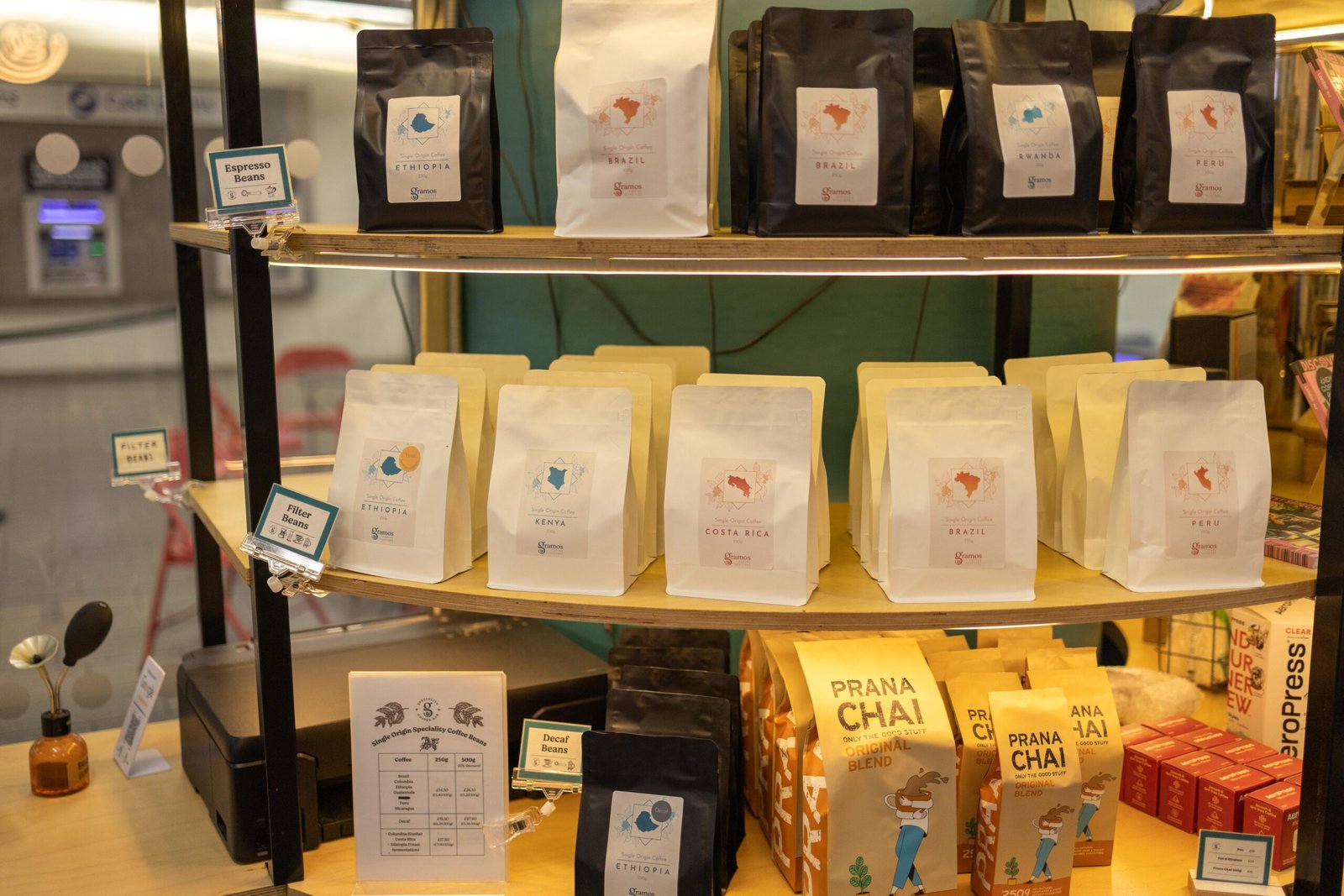
Gramos serves single-origin coffee exclusively, no blends, a real stance rather than a marketing line. “It comes from our want to celebrate the different coffee-producing regions,” Charlotte said. Blends, as she understands them, chase a safe, familiar, repeatable flavour. Single-origin does the opposite. “We like variety. We like character, we like personality, and we like trying new things. Even in our personal life, we will go to a supermarket and we’ll always try a new bottle of wine.”
Rodolfo doesn’t want the coffee to be about what Gramos has created, she said. “He wants to celebrate what the farmers and the natural land has been able to produce.” But it’s a real commercial risk, especially in a train station where people crave familiarity. “We will have a great Ethiopia coffee for about three months, and people will like it, and then we’ll change to Brazil.” It’s a risk, but as long as customers understand what Gramos actually stands for, variety, discovery, she believes people buy into it rather than resent it.
Beans have also become a proper second business, sold to home brewers and a small handful of London companies, entirely organically. “It grew out of demand, definitely.” Interestingly, most online customers turn out to live somewhere along the East Coast Main Line, York, Nottingham, Edinburgh, people who’ve physically passed through King’s Cross and taken a bag home with them. Charlotte sees the shop itself increasingly as a flagship rather than the whole business, wholesale beans as the next real growth phase, rather than opening a second physical location.
Asked what’s most surprised her over ten years, Charlotte didn’t hesitate long before landing on something that had happened just a month earlier. A customer walked in and told her he was glad he’d finally found them. She asked how he’d heard of them. “He goes, oh, ChatGPT. And I was like, we’re on ChatGPT?” She checked herself, asked AI tools directly which coffee shop was best near King’s Cross. Gramos came out on top, on more than one platform.
“I remember starting out five years ago in King’s Cross, and you’d Google coffee and it would come up after the fourth or fifth page. I feel so immensely proud that AI is taking notice of those reviews. That is hard work, from Rodolfo, especially with his product, but all of our team members too, who have been giving incredible service that has paid off.” It’s the whole business showing up in the answer, not paid advertising, but years of consistency being recognised by something entirely outside their control.
On a personal level, the biggest surprise runs the other way. Charlotte never wanted to own a business. She was perfectly happy on a salary, working for someone else. Owning one, she says plainly, has been “incredibly challenging emotionally,” and the maths rarely feels fair. “There is not an equal equation between hard work and financial reward. You can work really, really hard and still not get that financial reward.”
But there’s a trade she didn’t expect either. Rodolfo is currently in Bolivia with their seven-year-old daughter, visiting both family and coffee farms. Charlotte told him to take three weeks, to enjoy it properly, and stayed behind to run the shop herself. “Maybe not financially rich,” she said, “but time rich, that is probably one of the most special and surprising rewards that I didn’t expect.”
It’s a fitting note to leave on. Ten years, no real plan at the start, built out of a relationship rather than a business degree, and still, by Charlotte’s own account, a work in progress. A brand that only really found its own identity somewhere in the middle of building it. A shop that’s non-recognised by design, in one of the busiest two minutes in London, that’s chosen to win people over one hello at a time rather than through a hefty marketing budget. Coffee that changes on purpose, even when it costs them familiarity.
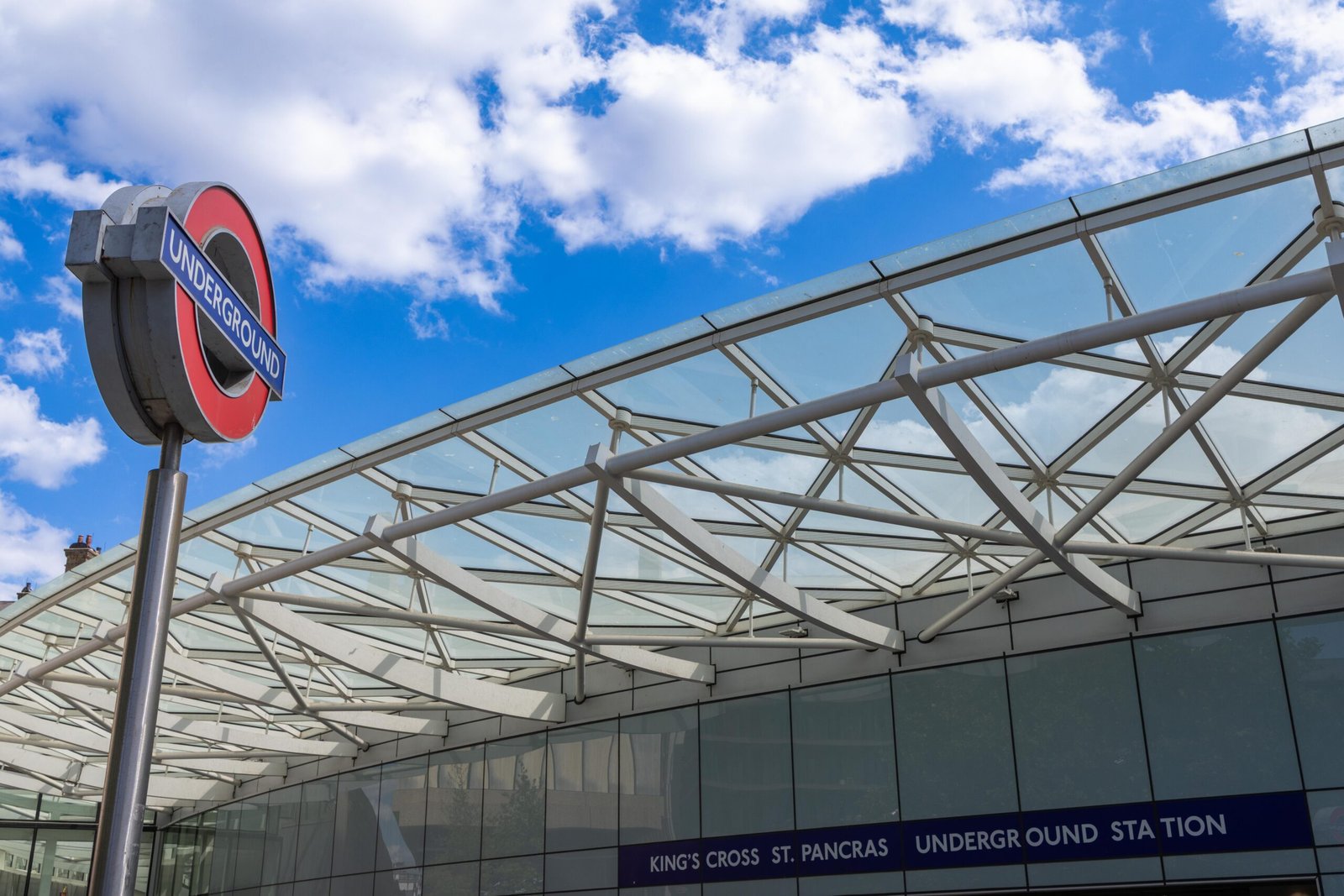
You’ll find Gramos one level down inside King’s Cross Underground Station, in the Northern Ticket Hall. Easiest to reach via the Regent’s Canal or Battle Bridge Place entrances, or the escalators by the Harry Potter shop. No ticket needed, just a great reason to stop, and a proper motorcycle bay at Chalton Street if you’re arriving the way I did.
I rode off not long after, back out into the heat, already thinking about the next excuse to come back.