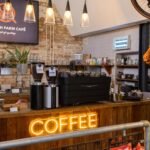

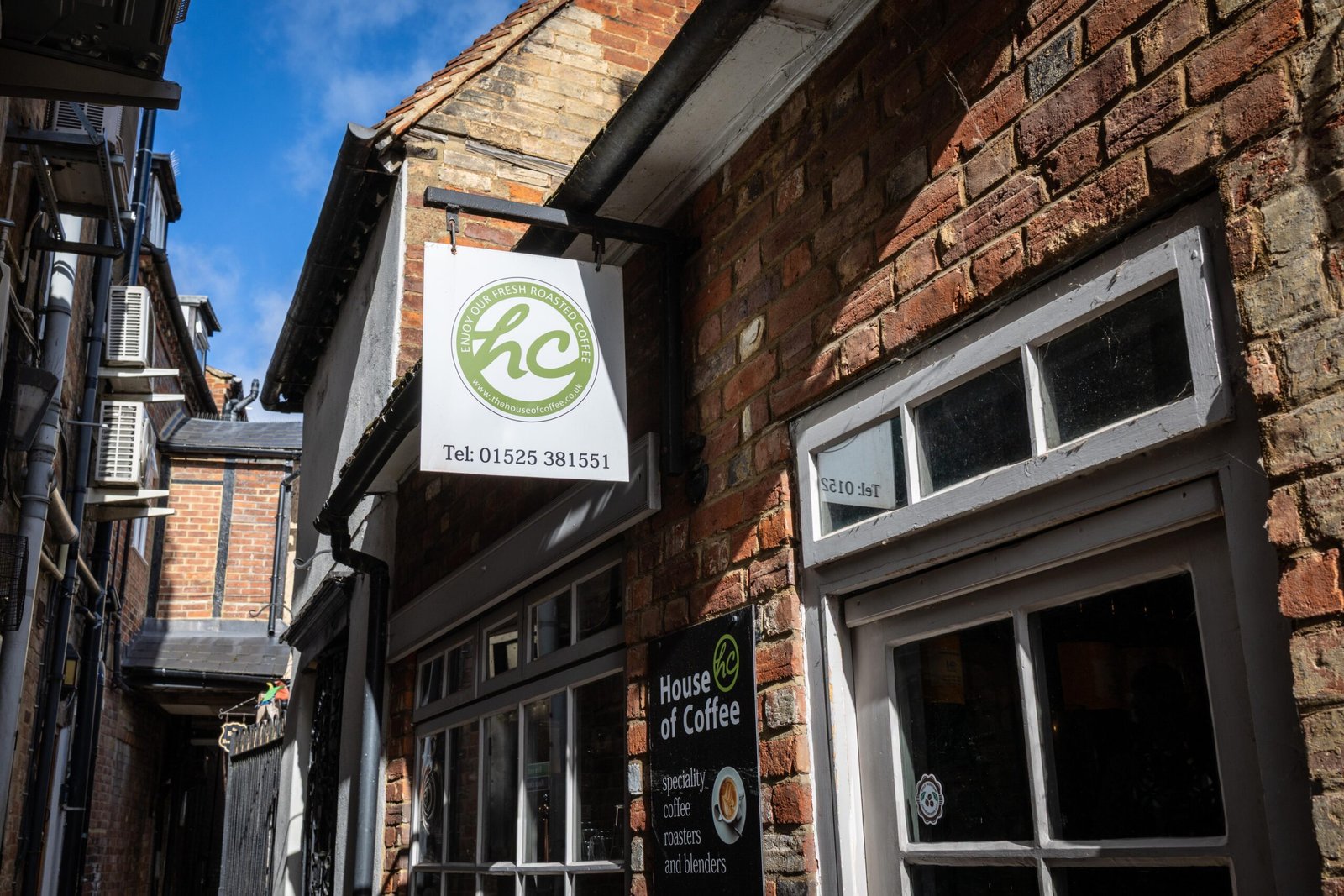
House of Coffee is a roastery and shop in the market town of Leighton Buzzard. It opened in 1984, and Nick, who owns it now, runs it from one of the town’s oldest timber-built buildings, which the shop’s own website dates to the early 15th century.
Nick bought the business in 2006, after the first half of his career as an accountant. What follows is mostly Nick in his own words, because a man who swapped management accounts for a roaster tells the story better than I can.




Before we talked coffee, we talked bikes. Nick had been reading about my Royal Enfield and the Flying Flea on this site, in Two Comebacks: Royal Enfield’s and Mine, and it turned out the Flying Flea was part of his own family’s story.
The first half of his career was accounts. The second half, however, is by his own count roughly a million cups of coffee.
Coffee is a moment, and that’s what we’re trying to create.
Nick, owner of House of Coffee
The Flying Flea in the family
Nick told me about his father, who was a dispatch rider in the Second World War. The Flying Flea was the nickname for the lightweight Royal Enfield that dispatch riders used, and in Nick’s house it was a family joke.
My dad was a dispatch rider in the Second World War. When he used to date my mum in Yorkshire, they used to talk about rides out on the Flying Flea across the moors.
…
That name, the Flying Flea, is very accurate and is definitely what they used to call it, because they used to laugh about it and the name of it. They used to go for rides out of there. Those were the good old days, you know.
Nick
A bike at 50
Nick rides too. I asked him about the bike in his photograph, and he called it his pick. But he did not start young.
I passed my test when I was 50, because my mum wouldn’t let me have a bike.
Nick
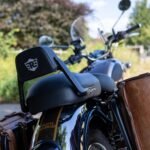
In fact, the bike he chose is a Suzuki GSX1400, one of the last of the model.
It’s a Suzuki GSX1400. When they first came out, I think it was in the 90s, it’s sort of like a bit of retro. They were blue and white, famous Suzuki colours of blue and white and posh pipes and that. But that was one of the last of the models they did.
…
When I got it, I thought, I’m going to go out. And it was fantastic. It was mind-blowing.
Nick
The Susten Pass
I asked where the photograph of the bike was taken. It was in the Alps, but he was more taken with the view than with the bike.
I went across some of the passes. I went to Interlaken and there’s some passes there. That was called the Susten Pass.
…
In the background of that photo, there’s a range of four, in a row, of the tallest peaks in the Alps, going miles into the distance, all lined up. It was really sensational, more than me being chuffed at my bike. The view, the vista if you like.
Nick

Taking up riding at 50
I asked whether starting late, as someone with a bit of life behind him, gave him an edge. He said it did, and that it also changed what he wanted from a bike.
Yes, definitely. Because you see too much in life at 52, you are a bit more cautious maybe. And also you have a different aspiration from a bike.
…
Despite that photo, I don’t want to be that fancy. Rather than racing about, or behing an aggressive driver I’d rather be a bit more steady, but with a bit more presence, you know.
Nick
However, he has not finished with motorcycles yet.
Well, I might get another bike, I hope.
Nick
An accountant who bought a coffee business
Then we moved on to coffee. I asked Nick to take me back to the beginning of his story with it. It starts with a contract, not a cup.
I was a freelance accountant for the first half of my career, and I got a contract with a big coffee company called Smith’s Coffee Company in Hemel Hempstead. I used to pop up and do management accounts and things. After a few years, an opportunity came up to buy a little business, and I was ready for a change. I loved the coffee business from seeing what the guys did at Hemel. So I bought into it.
Nick
The business was sold to him in 2006. It was not a start-up but, as he put it, already well established.
The business was sold to me 20 years ago, in 2006. It was bought as a going concern, and it was well established from 1984.
Nick
He also had help close at hand. Nick said he had friends down the road, including a former president of the Speciality Coffee Association Europe.
I had good friends, and so I jumped into it. I’ve been working very hard ever since!
Nick
He said that laughing, and then explained why he does not mean it as a complaint.
In accountancy you could relax from time to time. But coffee is so much fun. It’s not an effort. It really isn’t. I’m getting older now, but apart from that, it’s not an effort.
Nick
Why coffee is fun
I asked him why. His answer was about customers, and about what he did not find in accountancy.
Accountancy is quite rewarding in some ways, but I didn’t find a great deal of satisfaction at the end of the day. It’s the customer side of it. The satisfaction is creating a product that is going into many, many people’s homes and being a part of their day, part of their moment when they have their coffee. It’s what we put into it. That’s the core function, and it’s such a valid and good one.
Nick
A shop that has changed very little
House of Coffee dates back to 1984, so I asked how its identity has changed. The short version is that it has not.
It’s changed very little in its core. It’s based in the market town of Leighton Buzzard. It was opened by a gentleman who had lived in South Africa, as I understand it, and came to Leighton Buzzard with a solid knowledge of coffee growing and roasting, and established the shop.
…
At its core, it’s a local business for the service of roasting coffee.
Nick
The one big change is the internet, which he called a very important revenue stream. Then he came back to the building. Nick puts it at the 1600s, while the shop’s website dates it to the early 15th century. One thing is for sure, it’s got a heck of a lot of character.
You came into the shop. You can see that it goes back to the 1600s, that shop. Not much change is the answer.
Nick
From a Tilbury warehouse to a roaster two miles away
I asked whether House of Coffee roasts its own beans or simply buys them in. It roasts, and the journey starts at the docks.
The green beans we buy directly from importers, quite well established ones. From the list of green beans that come into the UK, into Tilbury Docks, we’ll typically buy half a tonne.
…
A large proportion of the coffee for the south east is held in one warehouse with 120,000 60-kilo sacks in it, from all different types of importers. They have this shed where it’s stored and we pick it up there. And we take it back and roast it, near our shop, about two miles away.
Nick
The range is wide. For example, Nick buys from about 20 countries and blends as well, and he put that down to the shop’s history.
We’re buying coffee from 20 different countries, and we’re blending it as well. That’s the legacy from when the shop opened. It’s a wonderful product range to offer.
Nick
Not a boutique roaster
I asked how he decides what to buy. His answer started with what House of Coffee is not, but he was careful with the wording.
We’re not like a lot of boutique roasters, if that’s not offensive. Our background is to buy consistently from a country. So we will have a generic Guatemalan special high grown, and it won’t be a single estate. Or we’ll buy Colombian Excelso coffee.
Nick
The point, he said, is that a named grade does the job for his customers.
Some people love Monsoon Malabar AA. As long as it’s qualified as that at the point of export, we’re happy to buy that. We don’t need to know more about the particular co-operative. That’s enough to tell us it’s the coffee we want, or Kenya AA, or Old Brown Java. We know what it’s gone through, what the parameters are, and that’s what our customers are looking for.
Nick
Sometimes he goes direct. For instance, there was a pear-macerated coffee from Nicaragua, which the shop’s website says was bought directly from the farm of Ben Weiner.
I think it’s actually shipped to Amsterdam and they ship it over. That involved pear maceration for 100 hours, and very unique coffees. We’ll just buy that direct.
Nick
The shop’s website describes the process as fermentation in wild tropical pears, and says only 25 kilos were available.
There is also a Christmas coffee on the way, and he stressed that it is fully traceable.
We’ve just got some Jamaica Blue Mountain in for Christmas, and a very small quantity of it. And again, we’ve got all the traceability of it.
Nick
One recent change is that House of Coffee has given up its Fairtrade licence. The shop’s website says it can now embrace a broader range of ethical, sustainable and diverse coffees under one label, which it calls its ESD standard, short for equity, sustainability and diversity.
We would look for women producers, for instance, or ones that had sustainable qualities.
Nick
Old school roasting
Roasting is both a technical process and a skill built up over time, so I asked how much comes down to data and how much to judgement.
We’re old school. You could fill a laboratory with spectrometers and particle measurement and all sorts, but we largely do it the old way, which is we do it based on colour.
…
We’ve been roasting largely the same coffees for so long that we do a consistent roast, based on what we’ve done over the years. We’re only changing things very marginally in the individual roast level.
Nick
The exception is the Jamaica Blue Mountain, which he plans to treat carefully. He is also modest about where his knowledge comes from.
Most of the knowledge in this, and probably any profession, you’re standing on the shoulders of giants. Someone’s already done it, and someone more qualified than me will have already gone to lengths to source and describe the coffee.
…
Maybe Colin Smith in Hemel, the former president of that European team. He would come in with a view that would be infinitely more valuable than myself. You know what I mean?
Nick
Outgrowing the five-kilo roaster
I understood that House of Coffee has two roasting operations, including a newer one outside the town, so I asked what prompted it. It came down to volume.
We just had a little five-kilo roaster in our shop, which was great. But we were knocking out, I think, like 20 roasts one day, and that was insane. So we needed a bigger roaster. It was a beautiful older Probat, but it had worn out its economic life really. So we needed to invest in a new one. We’ve got a 20-kilo roaster now and that’s great. We only roast 15 kilos in it.
Nick
He puts output at about 300 to 400 kilos a week, and says the second site came about five and bit years ago. What I liked, though, is how he paid for it.
What we did was mutually beneficial to a business where they were starting off. They were obviously going to be roasters, but they couldn’t roast yet. We did some contract roasting, and the volumes involved helped us pay for that machine, and got us on a different platform. We’re still good friends and they’re doing exceptionally well. That’s how I financed it.
…
Once you triple or quadruple your production, you’ve then got to fill it and justify it. And we managed to fill it for a couple of years with that.
Nick
What House of Coffee stands for
I asked which coffee in the range says the most about the shop. He started with the top end, and then brought it back to Leighton Buzzard.
We do some really posh coffees. I mean that nicely. We’re Leighton Buzzard, so we’re a pretty straightforward mixed bunch. We’re looking for some value, but also we appreciate a treat. We do some very basic blends too, but some of them you wouldn’t change. A simple Brazilian, and some Ethiopian, a little blend.
Nick
The coffee he mentioned next is a simple one, and it has caused a surprising reaction. Nick created a breakfast coffee, and then he renamed it.
We created a breakfast coffee, which I’ve renamed Rise and Shine, but there’s been a big kickback. They’re like, after 40 years, why have you changed the name of this? So it’s just a smooth, well balanced wake-up to the day.
Nick
How the British relationship with coffee has changed
Nick took over in 2006, so he has watched the average customer change. I asked what it was like then and what it is like now.
It’s much more sophisticated. When I got in, it was the last throes of people having filter machines at home, and in pubs and many restaurants you just got filtered coffee, which is fine and good. But slowly we’ve got the traditional espresso machine revolution, with all cafés and restaurants.
…
The coffee drinkers now, and the younger generations in particular, are much more educated and much more sophisticated in their requirements of a cup of coffee. They’ll pay more and go to more trouble to get a coffee that they like, rather than the one that’s presented to them in the nearest café.
Nick
Working from home since Covid has changed what the business sells, too.
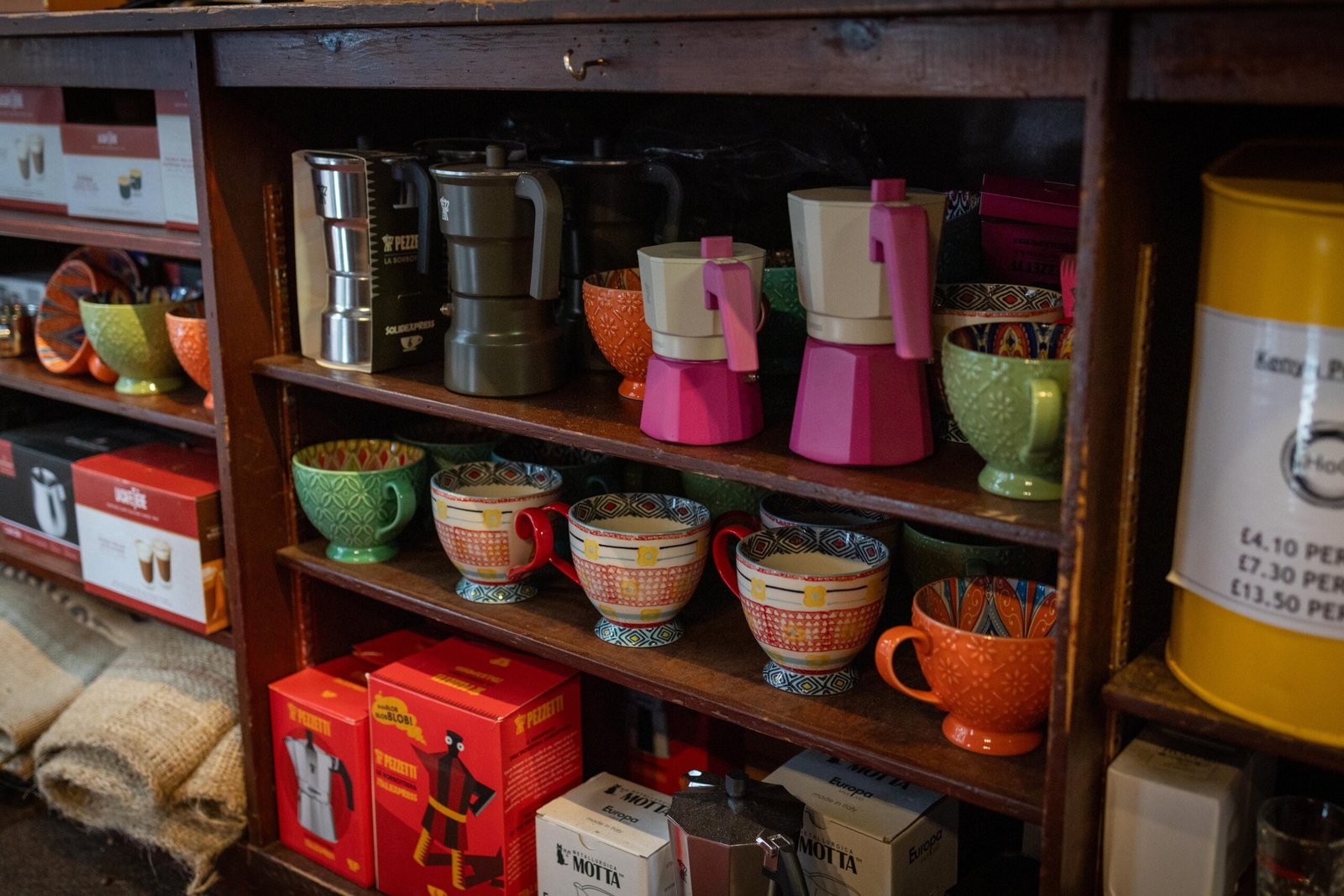
There’s a boom now in home sales, and basically in what we do, shipping kilos of beans to people. To the cost of the hospitality industry, many of our customers now are making their posh drinks, or their fancy milky drinks, from home.
Nick
Advice at the counter
I had seen on the shop’s Instagram that it offers advice, so I asked what people come in wanting to know. Nick said it is a bit of everything, and that it starts with simple questions.
Some people that are new to it, or new to us, we ask some very simple questions. We ask them what machine they’ve got, and would they describe their coffee as mellow or medium or strong, and why. When do they drink it? Is it for breakfast and they want a gentle wake-up, pre-exercise, or all sorts of reasons? We get asked about equipment quite a bit.
Nick
What the shop does not have is the space to teach.
We don’t have any place where people can do a tasting or some training. If we had a spare room, we could do training classes. That would be nice, but we haven’t got room for that. And we’re pretty busy.
Nick
A million moments
Partway through our conversation, Nick stopped to say something the questions had reminded him of. It became the line I kept coming back to.
The volume of coffee that we do makes about a million cups of coffee. We roast 15 tons, and at 15 grams, that’s a million cups of coffee.
…
It’s like a million moments to us. Coffee is a moment, and that’s what we’re trying to create. So when a customer comes in, we’re trying to interpret that moment. And if they come back and say, that is my favourite, we know we’ve done it.
Nick
He went on to say what he thinks coffee does for the person drinking it.
I’ve always appreciated that with coffee, it takes you out of wherever you are. You drink it, and it’s like you’re touching base with something. In that moment, your brain is coming home. The only way I can describe it is, we are creating a moment for people.
Nick
Less is more
I asked what people misunderstand most about a good cup of coffee. His answer was one word.
Volume.
…
In the UK, and maybe it’s not true now, you see some of these big retailers do a trough of cappuccino, and I think we’re missing out on something here. Less is more. Go to Rome, go to a back street café, and have a cappuccino. That’s a good cappuccino.
…
Sometimes we look and we think, wow, that looks brilliant. But just focus more on what you want your tasting to be, rather than what the impression is.
Nick
Shop first, website second, both vital
House of Coffee has kept a physical shop in Leighton Buzzard while building an online business, so I asked how important that mix is.
Oh, it’s vital. Absolutely vital, especially with the pressure that high streets have. We’re bucking the trend really, in terms of high street viability. We’re getting stronger and stronger. But nonetheless, we would have a problem without the website.
Nick
I asked how the shop keeps its personal approach as it grows, and his answer made him laugh.
Well, not very well. But we do have a news page, and what we’re trying to do with the business is keep it real. Have that intimacy that we have with our local customers that know us as people. On our website, we will have a news cutting that might have a photo of us doing a local event. But we do struggle with that.
Nick
Social media is a work in progress. The shop now has someone who looks after it, and a recent reel did better than usual.
I just put out a reel last week and it got about 900 views, which is great for us. We’re not big in it, so we could do more.
Nick
What still excites him
After so many years in coffee, I asked what still excites him about it. The answer was people, not beans.
Meeting new people and finding out how they’re doing, and their careers. It’s a small industry really in some ways, and it’s just networking, and that’s fun.
Nick
When I asked what he is still trying to learn, he talked about travel.
I need to go overseas more and find the money to do that, so that I can go back through the process with a much better understanding and develop a network. I’d love to do that, but whether I’ve got the time, I don’t know. But I’m happy with where we are. And I love the work.
Nick
The next five to ten years
I closed by asking what the next five to ten years look like for House of Coffee. He laughed, and then gave me a plan.
Oh well, I think I’m going to be retiring. I want to retire sooner rather than later, so I can cycle out on my bike.
Nick
He does not think the shop’s story ends there. He thinks someone younger could take it much further.
If you got the right investment, and are young enough, they could take House of Coffee and put it in every viable high street in the UK. And they would make a fortune. The time is perfect for that, because of the big upturn in drinking freshly roasted coffee and the awareness with the public.
Nick
His last line is the one I will keep.
It’s worth paying more for a really good coffee, locally roasted.
Nick
Where to find House of Coffee
House of Coffee is at Peacock Parade on Lake Street in Leighton Buzzard. Look for the hanging sign. The details are in the Quick facts box at the top of this story.