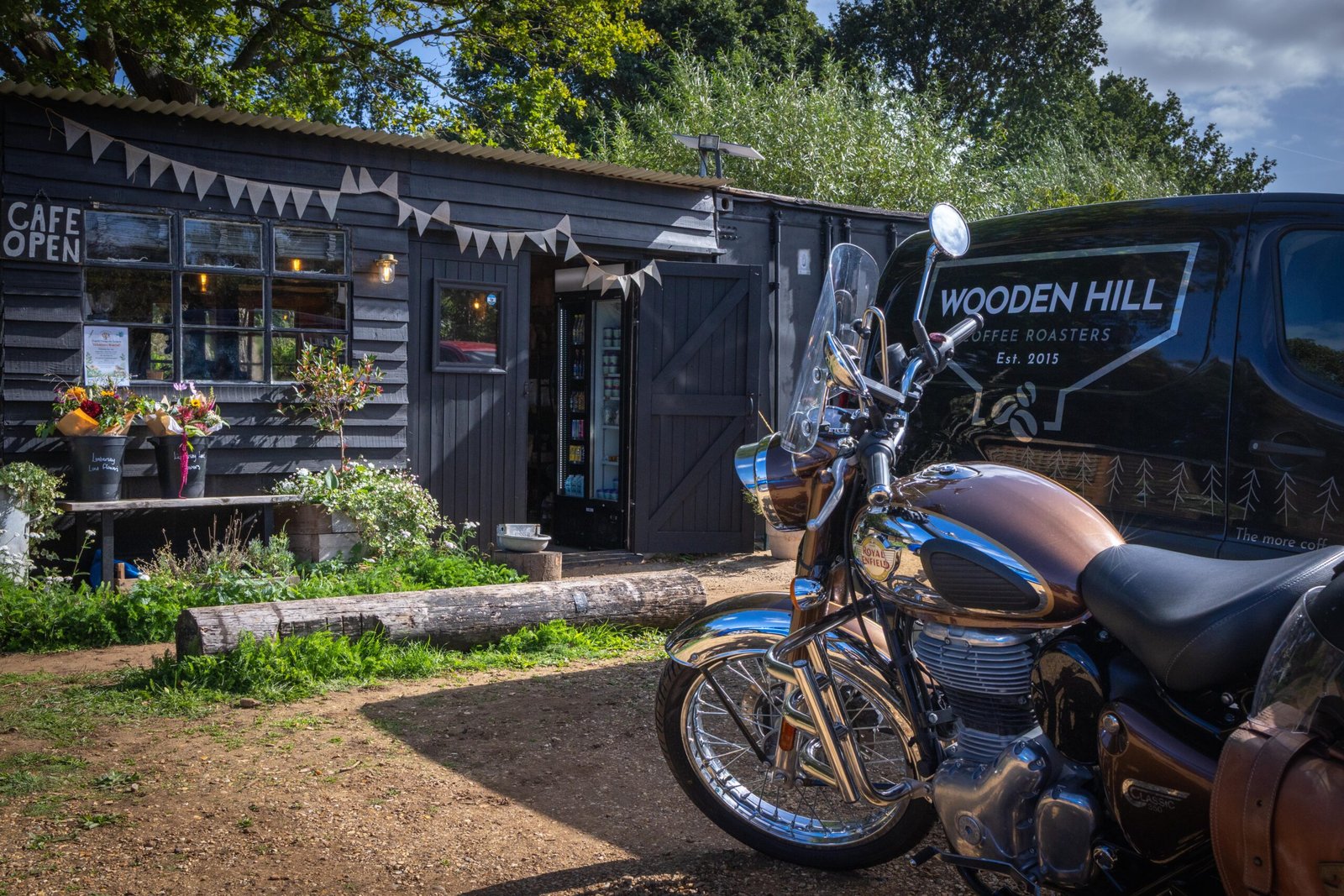

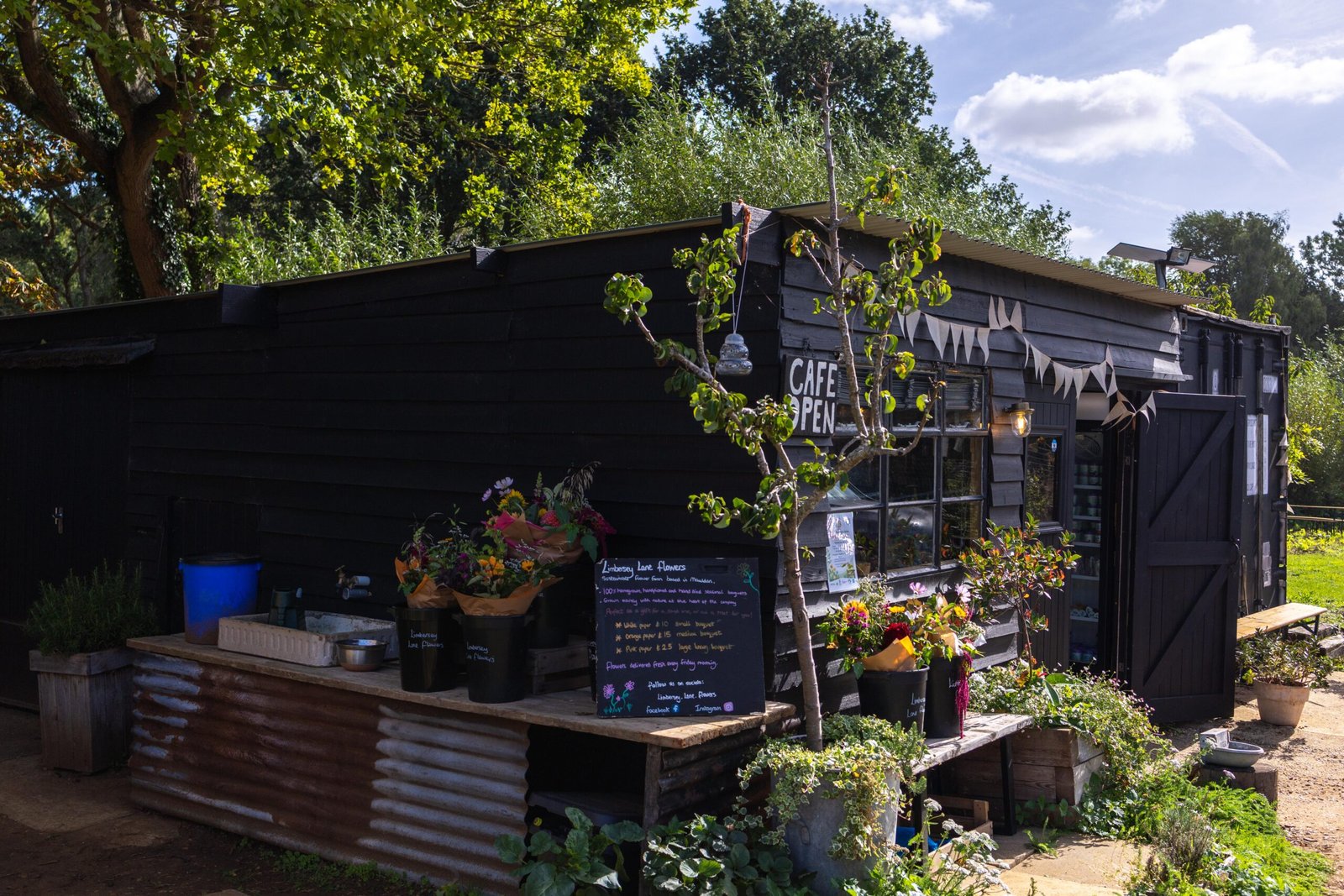
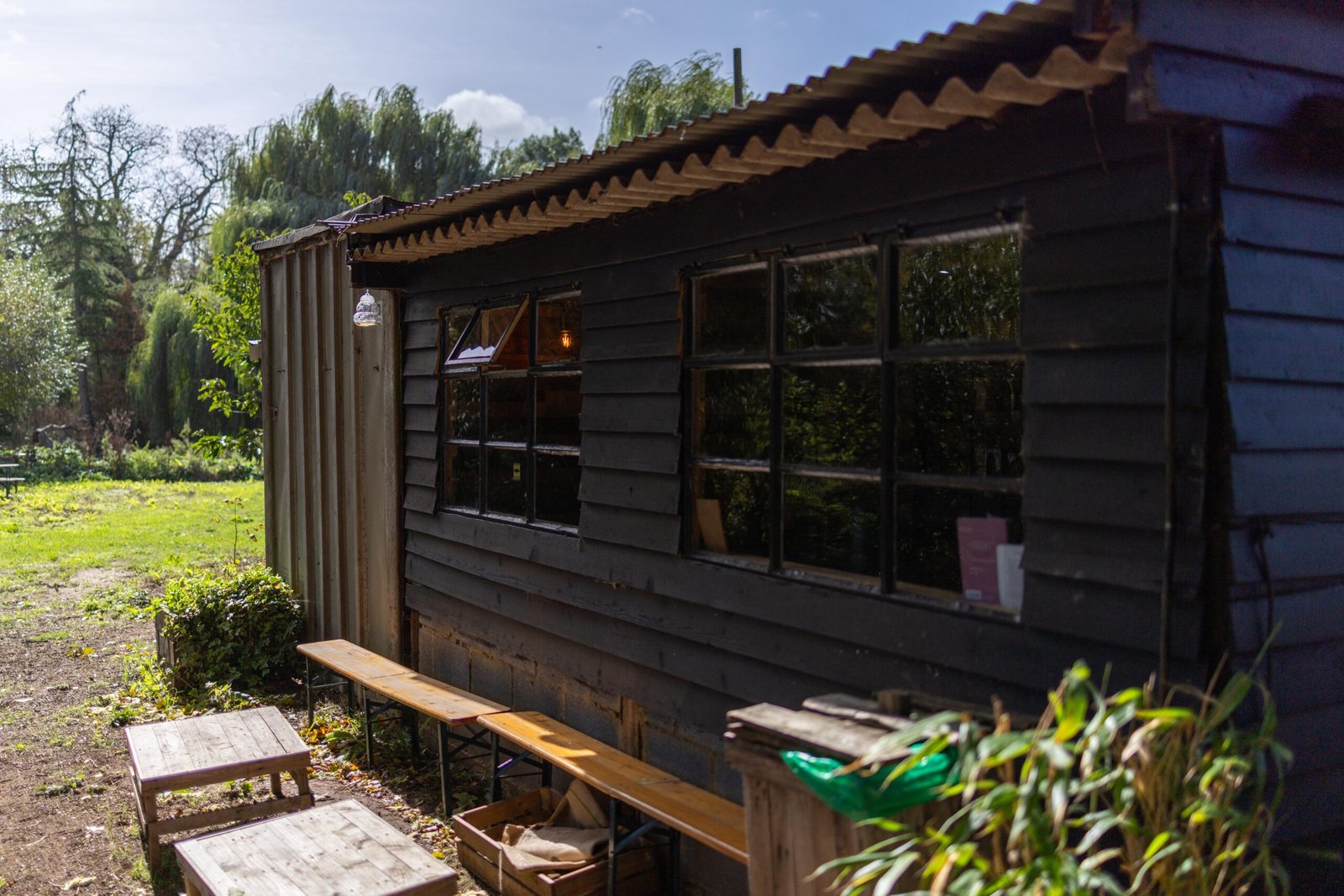
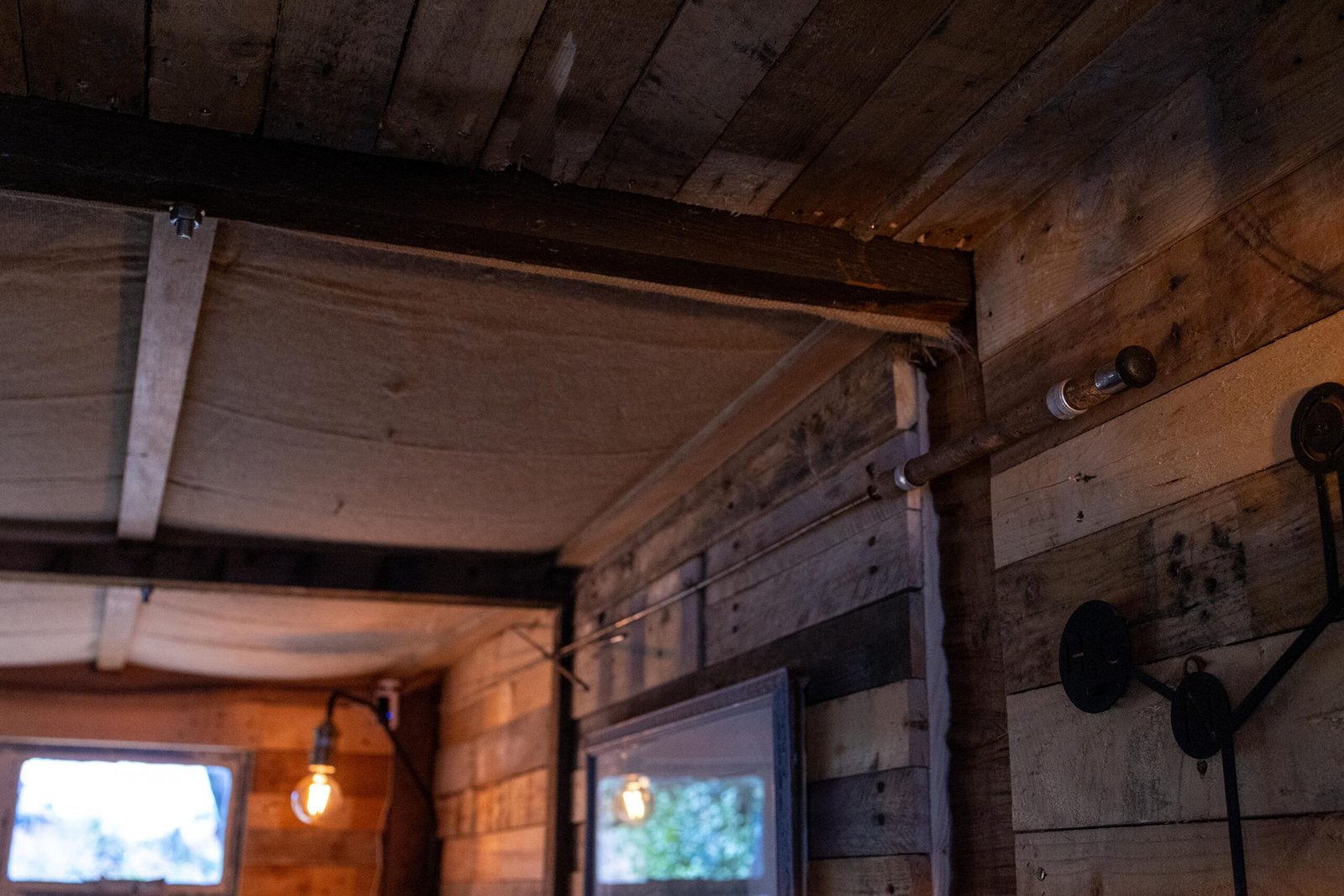
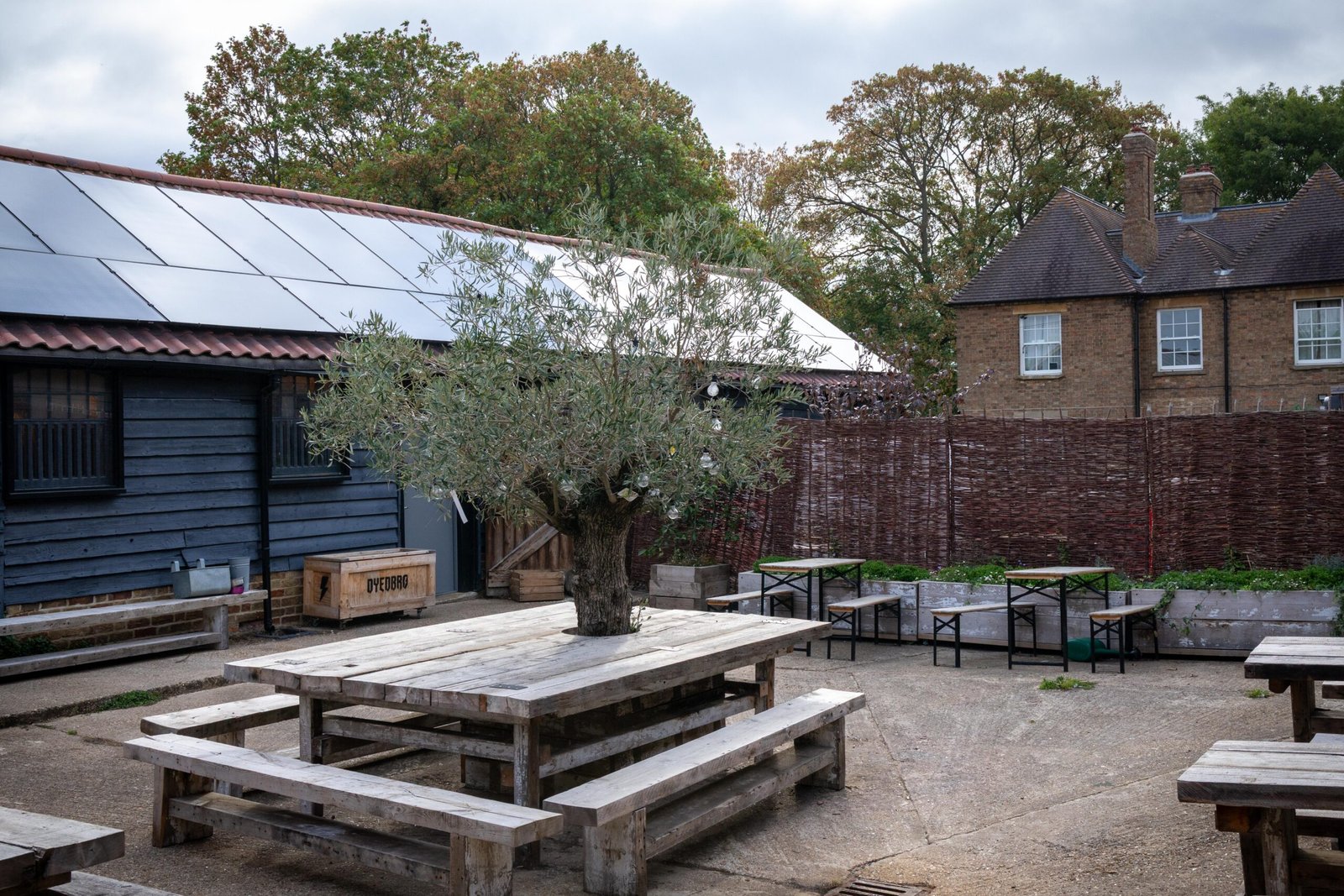
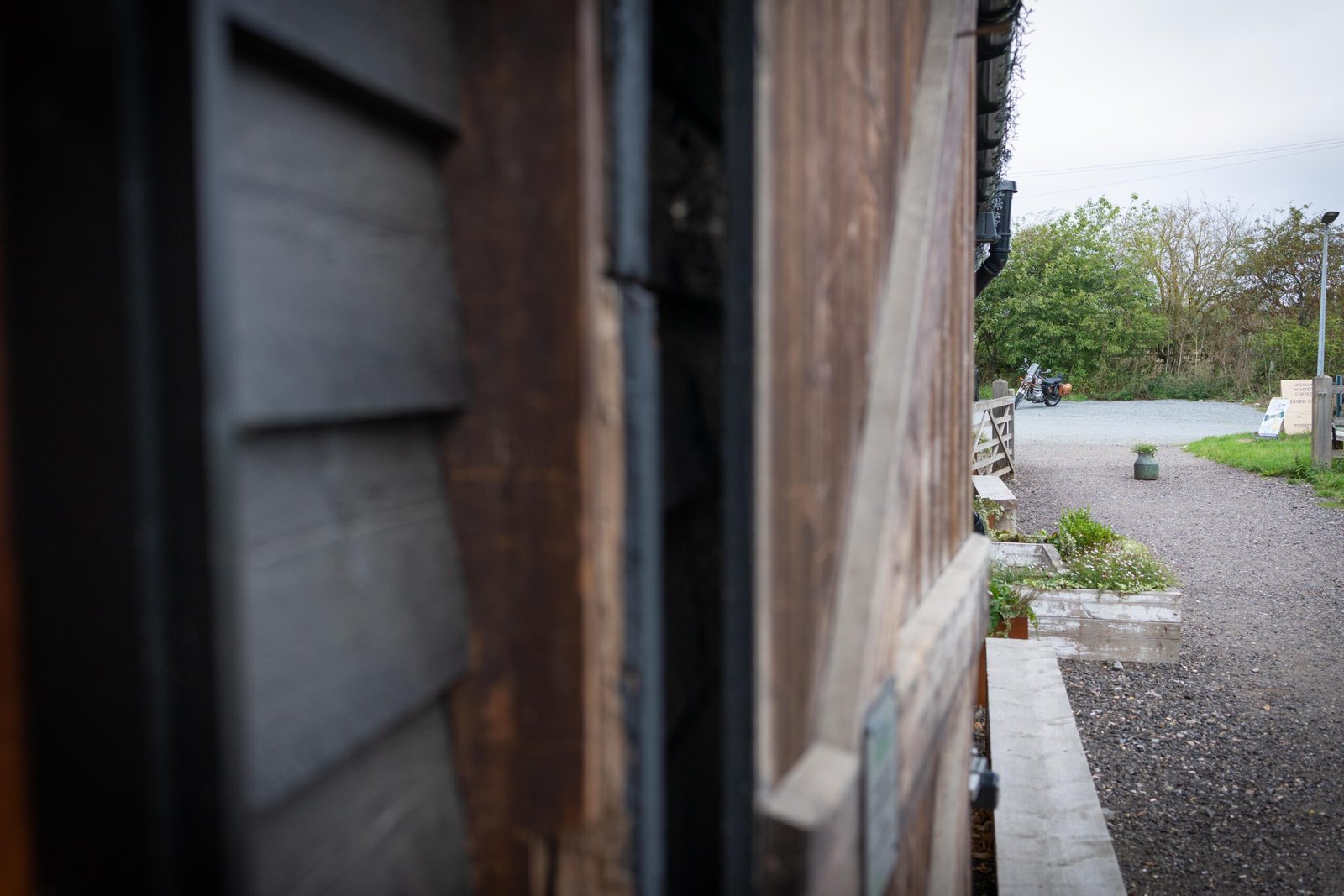
Riding into the Maulden Cafe of Wooden Hill Coffee, the smaller of the company’s two sites, feels a little like being transported back to rural Pennsylvania. That’s where I grew up. The former bait shed, which has replaced their old home in Millbrook, blends seamlessly into the surrounding landscape.
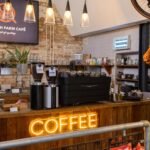
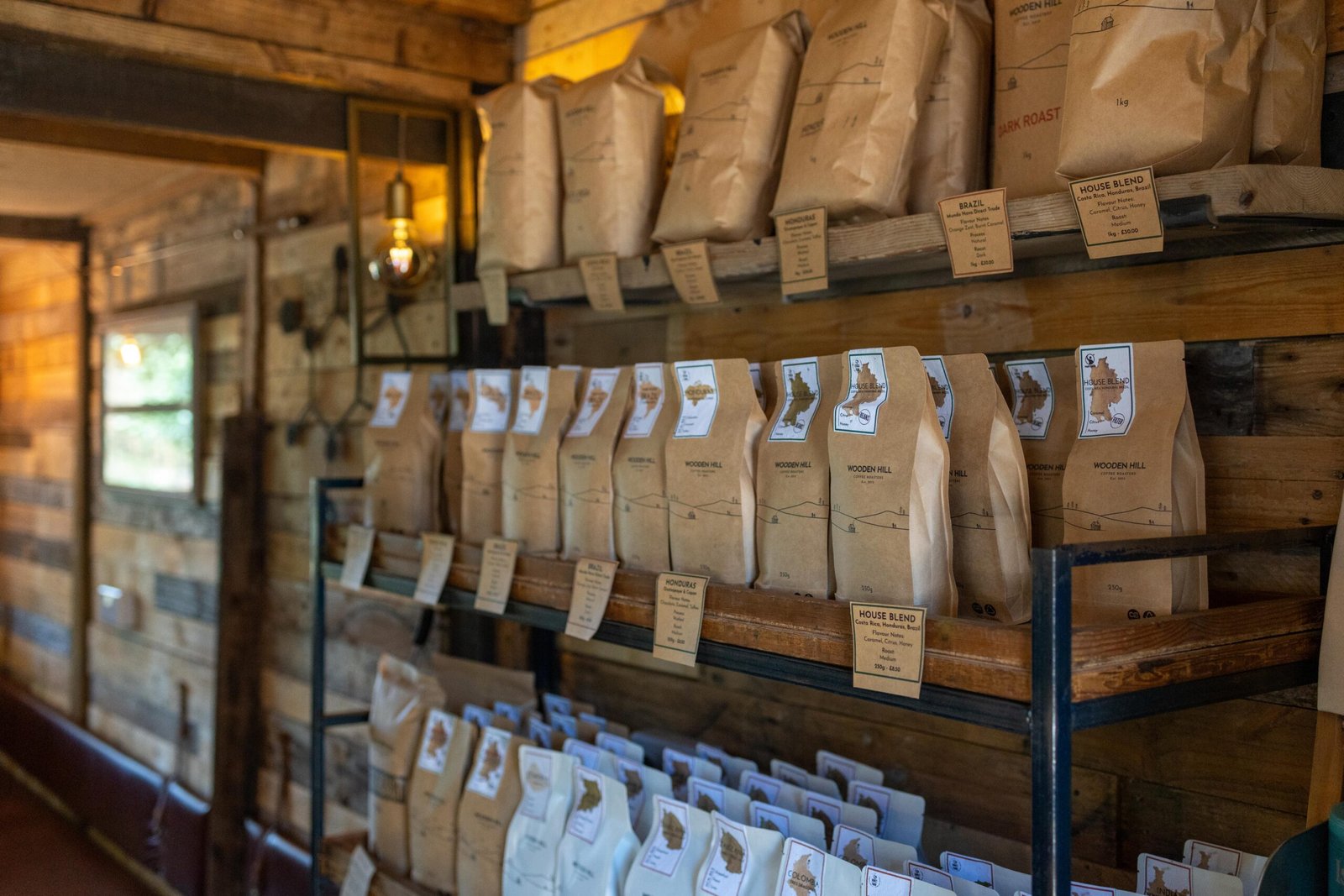
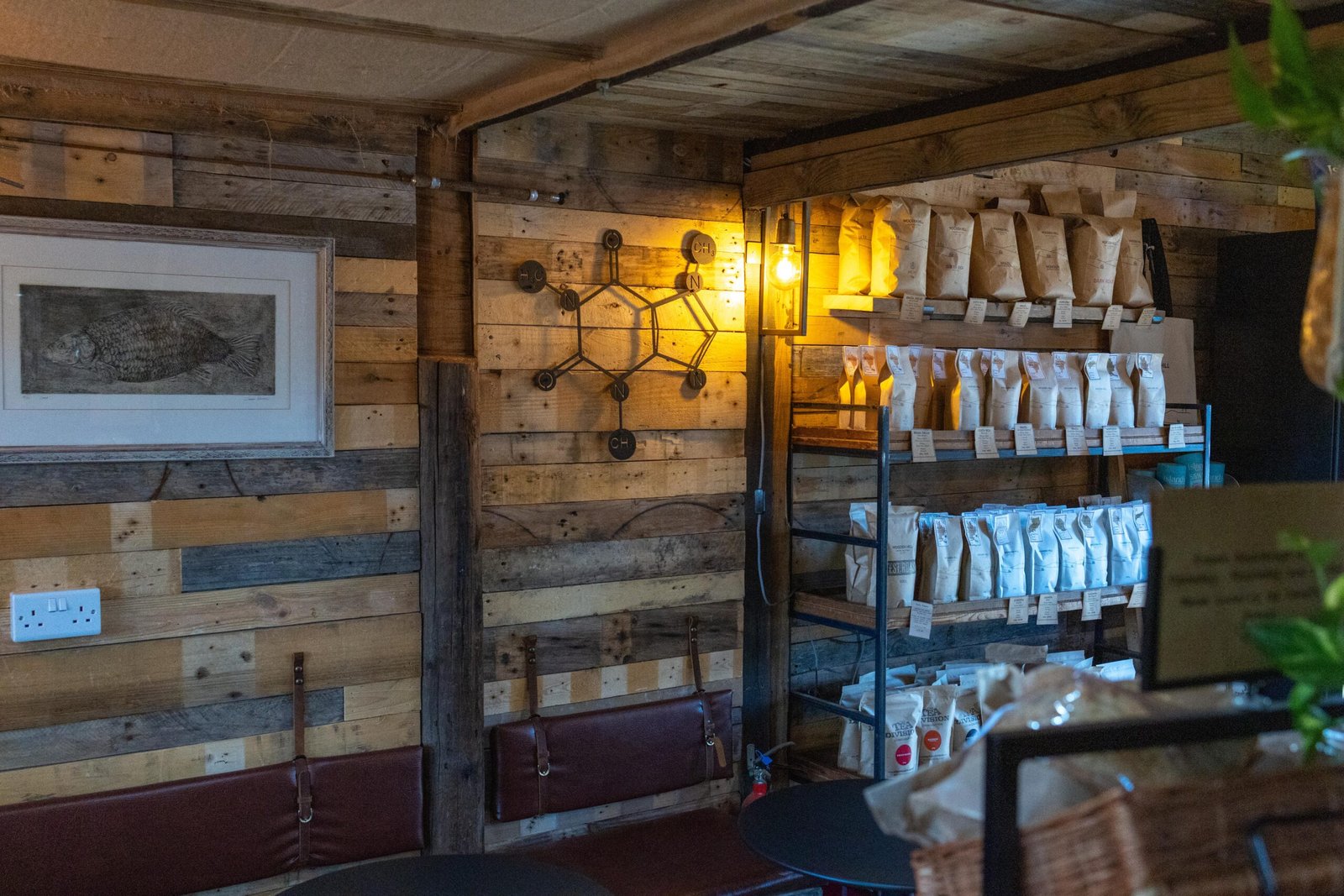
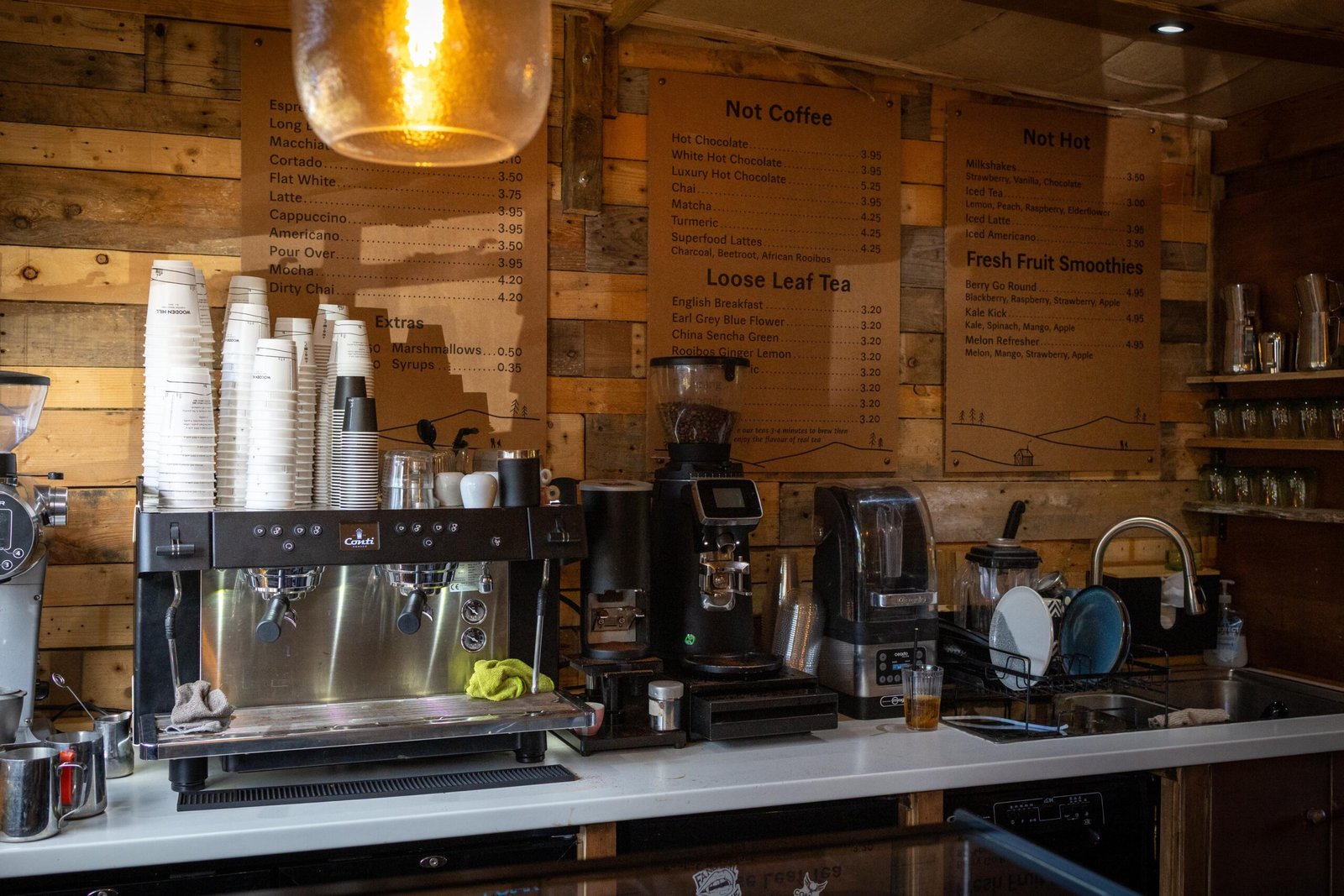
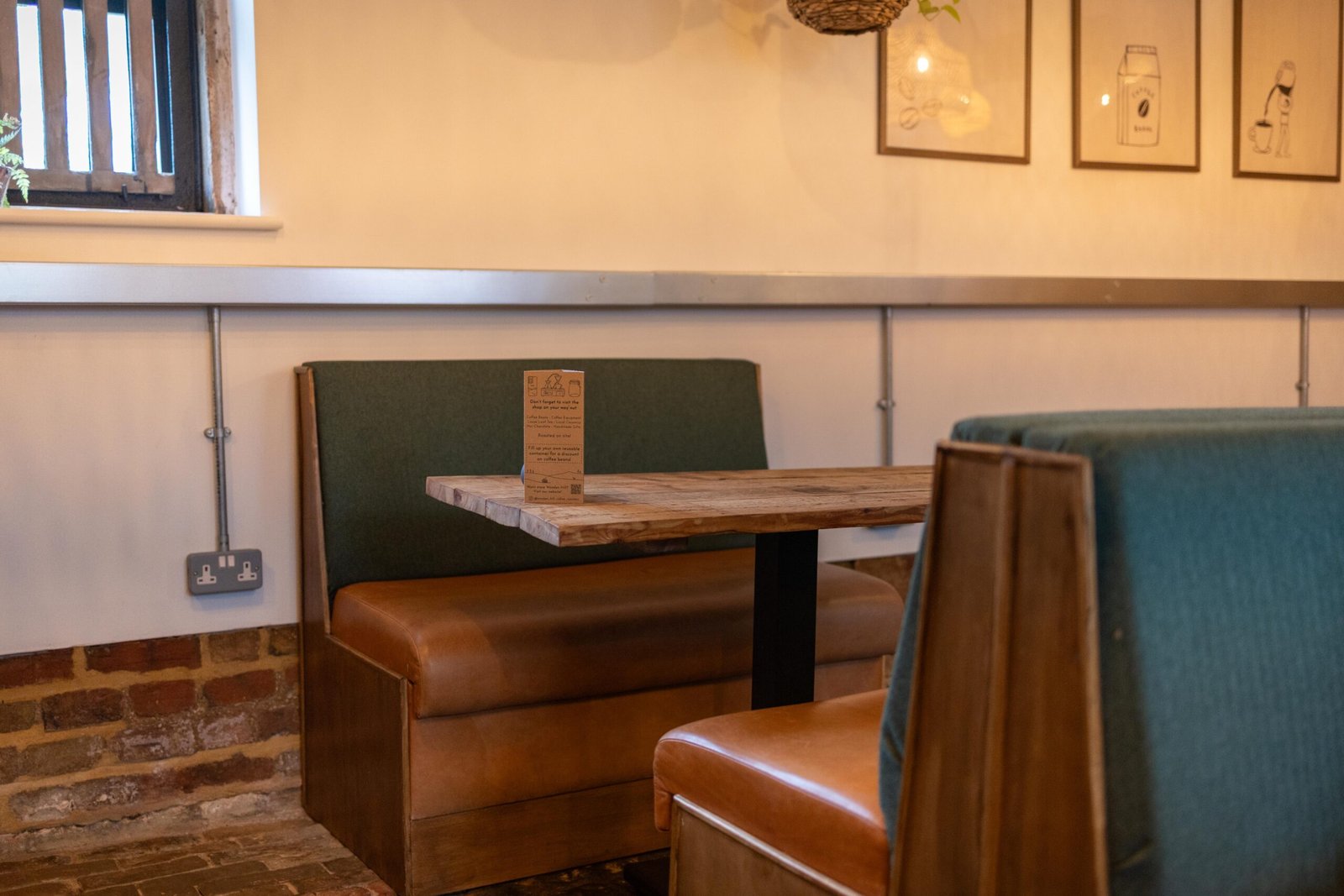
Inside, reclaimed timber walls, exposed wood finishes and soft ambient lighting create an intimate, cabin-like atmosphere. There’s seating inside but on a day like today everyone is outside in the spacious garden.
I’m here to meet Robin, who started Wooden Hill Coffee in 2015. Later, I’d head on to Haynes, home to the roastery and Wooden Hill’s bigger shop. For now, though, we find a picnic table and settle in for a chat about his journey into coffee.
Flying to Sydney to Find a Real Cup of Coffee
Robin didn’t always like coffee. Growing up, his uncles worked for General Foods in Banbury, the company behind Mellow Birds instant coffee. University meant surviving on little cardboard “max packs” of instant powder that he mostly gave away. “I hated coffee anyway,” he said.
That changed in 2000 when, at 24, he flew to Sydney, “just to travel like people do.” He landed a job in a coffee shop despite still disliking coffee, spending his days on the floor while a colleague worked the espresso machine.
On his first day, tired and automatically reaching for tea, he was handed a flat white instead. “Flat white didn’t exist in the UK in 2000,” Robin said. “I didn’t like coffee, but he gave me one, and it looked amazing. I tried it and went, ‘Oh, that’s coffee.'”
The colleague, Tim, had trained at what Robin still calls “Coffee University” in Sydney. In an era before smartphones, Instagram and endless online food content, seeing real latte art for the first time was a revelation. “It’s pre-media,” he said. “You didn’t see it anywhere.”
Learning What Coffee Means
Working the floor taught Robin about coffee culture, and where people fit into it. One day, when his colleague had a day off, a regular came in and Robin offered to make his usual order himself. It was only an americano, and Robin could handle that, but the customer said he’d give it a miss.
“They want this guy, this barista,” Robin said. “He doesn’t want me making it. It was at that moment you go, this means something.” For the first time, he saw that people weren’t simply attached to a coffee order. They were attached to the person making it.
Another small detail caught his attention. Most mornings, around 11 o’clock, two young men about his age would come in and share a flat white together. “If it was me and my mate, we’d be in the pub,” he said. “There’s no way we’d meet outside in public at 11am and have a coffee together.”
It seemed insignificant at first, but it revealed something about the way coffee sat within Australian life. It wasn’t just a drink. Instead, it was a social ritual, a reason to pause, catch up and spend time together. For Robin, it was one of the first signs that coffee could be woven into a culture in a way he’d never seen back home.
Selling Coffee for Illy
Back in the UK, Robin moved in with his parents in Stratford-upon-Avon and took a job managing a cafe serving Illy, the Italian coffee brand. Within 18 months, opportunity arrived unexpectedly. A sales representative who supplied the cafe left her role after becoming pregnant and recommended Robin to her manager.
He joined Illy in 2003, just as coffee was becoming fashionable in Britain. “Everybody had watched Friends, they’d seen Central Perk,” Robin said. Over the next 13 years, he worked his way up from area representative, installing, servicing and dialling in espresso machines. Eventually he managed a team of around 11 reps across the country.
By the early 2010s, though, he noticed a shift in the industry. Small independent roasters, some operating from the boot of a car or a spare van, were quietly winning business from cafes that had relied on established Italian brands for years. While his own managers saw the trend as a sales problem to be solved with incentives and free equipment, Robin believed something more important was happening.
The independents were succeeding not because they had bigger budgets or better deals, but because they were present. “This is about the relationship between the local coffee business and the owner of the cafe.”
They knew their customers, understood their businesses and had become part of the local coffee community. Watching that happen planted a seed. The future of coffee, Robin began to suspect, belonged not to distant brands, but to people rooted in the places they served.
Starting Wooden Hill
Robin spent two years talking about starting something of his own before finally taking the leap in 2015. “…if I don’t do this in the Bedfordshire area, someone else will,” he said. Even the name reflected a sense of place. It comes from the old nursery rhyme phrase, “up the wooden hill to Bedfordshire”, a traditional way of describing the climb upstairs to bed.
Without a roaster of his own, Robin approached a contract roaster in Leighton Buzzard. The first answer was a flat no. Three minutes later, the phone rang. “Should we have a conversation about this?” That conversation became the foundation of the business.
Robin wasn’t backed by investors or family money. The decision meant walking away from a career he very much enjoyed. “I’m giving up a job I really, really like…a decent salary and a company car, on a whim, on a dream, with a belief that it might work.”
In the early days, he did everything himself. He drove the van, hand-stamped every bag, and delivered orders personally, building the business cafe by cafe, customer by customer.
Building the Roastery
Even as the business grew, something was missing. Customers kept asking to visit the roastery, and Robin had to explain, honestly but carefully, that it wasn’t really set up for visitors. “I wanted that full package,” he said. He’d visited other roasteries himself, including Monsoon in Warwickshire, and knew what he was chasing.
The push finally came when his contract roaster, Nick, called to say he no longer wanted to roast for Wooden Hill. Privately, Robin was thrilled. “Internally I was kind of punching the air, thinking, great, this is the catalyst.” He’d already done the sums on setting up his own roaster that same weekend.
“Don’t worry, I’ll teach you how to roast. It will take around six months realistically,” Nick said to Robin and shortly afterwards Wooden Hill’s own roastery opened in Millbrook, a small village near Ampthill.
You Can’t Do This Alone
Not long after opening the roastery, Robin was asked a question by his wife, Nicola, who incidentally he had met for the first time in Sydney airport back in 2000. That had truly been a life-changing trip for Robin. Nicola doesn’t drink coffee, but she had watched Wooden Hill grow from an idea into a business that mattered deeply to their family. One day she asked him what would happen if he was no longer there to run it.
Their children were still young, two, six and eight at the time, and she had no desire to take over herself. “I don’t even like coffee,” she told him. “I don’t know what you do.” The question forced Robin to think seriously about the future and the people that could help carry the business forward. One of those people was Jack. Having helped out on his days off from another job, Wooden Hill offered him a full-time role, and he joined the business in January 2020.
A Footpath Through Lockdown
Two months later, the country entered lockdown. Robin almost immediately had to furlough him. But while working through the government guidance, they realised they could open for takeaways. Instead of shutting completely, they reopened the unit’s doors and adapted.
The timing proved surprisingly fortunate. A public footpath ran nearby, and as people headed out for their daily exercise, they discovered they could stop for a coffee. Many, like the Nordic Walkers, returned the next day, and the day after that. “That footpath became well worn,” Robin said.
“People would ask about Wooden Hill, learn we were supplying local businesses like Surfin Cafe in Amptill and others…that’s where the business started to take off, we’d been going for five years but it was lockdown that introduced us to the local market,” Robin said. And, it made a difference to cashflow as well. “It was nice to go from wholesale to being a little cafe…customers give you money in advance,” he said while laughing. It made a change from delivering a product, sending an invoice, and then hoping for payment a few months later.
Doing Things Right From the Start
A flock of geese drifted past the otter-proof fencing beside our picnic table as Robin explained that sustainability had been built into Wooden Hill from the very beginning.
Back in 2014 and 2015, compostable coffee bags were difficult to find, so Robin sourced them from a supplier in Germany. Wooden Hill delivered wholesale orders in reusable wooden crates, which were later replaced by ten-kilo buckets that could be collected, refilled and returned to customers rather than thrown away.
“It was always about being an environmentally friendly company,” he said. Much of the industry was still relying on single-use packaging. Wooden Hill was already looking for ways to keep materials in circulation and reduce what ended up in the bin.
Planting Trees
In 2016, Wooden Hill began a partnership with the Forest Centre at Marston Vale, planting a tree for every 100 kilos of coffee sold. It is a commitment that costs more than customers might imagine. The trees may arrive as modest saplings, but they are planted within managed woodland, with years of maintenance and care built into the price.
The trees are real, local and visible. “If someone goes, we plant a tree, and they don’t tell you where, then I don’t know what it is,” he said.
Since the initiative started, Wooden Hill have planted more than 2,500 trees. Customers have even joined the process themselves. Planting days at sites in Silsoe and Flitwick have brought families together to put trees in the ground, with some returning later to see how they have grown.
What Doesn’t Make the Cut
Not every batch that comes off the roaster makes it into Wooden Hill’s regular range. Sometimes a minor fault in the roasting process, such as a pressure leak in the cyclone system, leaves a batch falling just short of the company’s own standards. It still remains, in Robin’s words, “bloody good coffee.” Other times, a coffee arrives in quantities too small to justify a full production run.
Rather than let those beans go to waste, Wooden Hill now sells them as unbranded test bags, offered at a lower price and with almost no explanation of what’s inside. Robin suspects that mystery is part of the appeal. “I think grown-ups are like kids buying blind bags of Lego figures,” he said. This particular endeavour has only been going for around six weeks. It shows that Wooden Hill remain committed to trying new ideas that will have an impact on the environment.
One earlier experiment was a blend created from leftover coffees that might otherwise have sat unused. Robin named it Mixed Up, after the remix album by The Cure, a nod to his long-standing love of the band. Despite its improvised origins, customers embraced it just as enthusiastically as any carefully planned release. For Robin, it was another reminder that good coffee does not always have to take itself too seriously. Sometimes a little curiosity is enough.
Expanding the Team
As the wholesale side grew, Jack moved from packing and roasting toward overseeing deliveries and customer relationships. Wooden Hill brought on Joe at the end of 2020 to take over the roasting. Joe, Robin says, gravitated naturally toward the research side of the job, visiting other roasteries to trade notes, including Broadway Roasters in Portsmouth and Purbeck Roasters in Bournemouth. That kind of exchange matters to Robin. “There’s not many of us out there, so we should be able to communicate and share.”
That community extends further than just visits. When Wooden Hill needed extra decaf at short notice, Steve at Yellow Bourbon and another local roaster stepped in without hesitation. When a fellow roaster’s machine broke down, he came to Wooden Hill for advice on getting it running again. “That’s the industry for me,” Robin said. “It’s not competition. It’s a support community.” He points out that the real competition was never other independents anyway, it’s the Costas, Starbucks and McDonald’s still dominating the market. Every customer who chooses an independent shop over a chain, in his view, is a shared win.
It’s All About the People
These days, Jack is Robin’s right hand. As Wooden Hill’s wholesale business has grown, he has moved well beyond packing orders and helping on the roaster. He now takes responsibility for deliveries, customer relationships and a small team of four.
Yet some things have remained unchanged. Every order is still roasted, packed and delivered by Wooden Hill’s own team rather than handed over to a courier. For Robin, that decision comes back to the same principle that has guided the business from the beginning. “It’s all about people,” he said. “People buy from people…it’s all about that customer engagement.”
Nikki, Wooden Hill’s cafe manager, has her own long history with the business. The two first crossed paths in 2003 when she worked at a cafe Robin supplied during his time as an Illy representative. It would be another 19 years before she officially joined his team. Today, she oversees both Wooden Hill cafes and manages around 15 staff across the two sites, helping to shape the customer experience that has become central to the company’s reputation.
Despite the growth of the business, Robin is reluctant to paint himself as a typical managing director. While others oversee roasting, wholesale accounts and cafe operations, he is just as likely to be dealing with the less glamorous jobs that keep everything running. Asked about his own role, he answers with characteristic understatement. “I’m the one that jumps on the bins.”
From Millbrook to Haynes
Millbrook, Wooden Hill’s original home, had become increasingly difficult to justify. The access road was so rough that Robin compares it to “the moon landings.” There were tensions with the landlord too, and the site wasn’t open at weekends. In addition, “the roaster was getting on a bit. It was only six years old but had a lot of miles on it,” Robin said. There was a contingency plan in place in case of any breakdowns. It involved getting down to Smiths Coffee Co in Hemel, a journey that wasn’t sustainable in the long term.
“I wanted a new roaster, and I wanted a new facility,” Robin said. “After knocking on a lot of doors, and being rejected a lot, being shouted at by farmers who wanted to know why I was on their land…we finally found a place at Haynes,” he said.
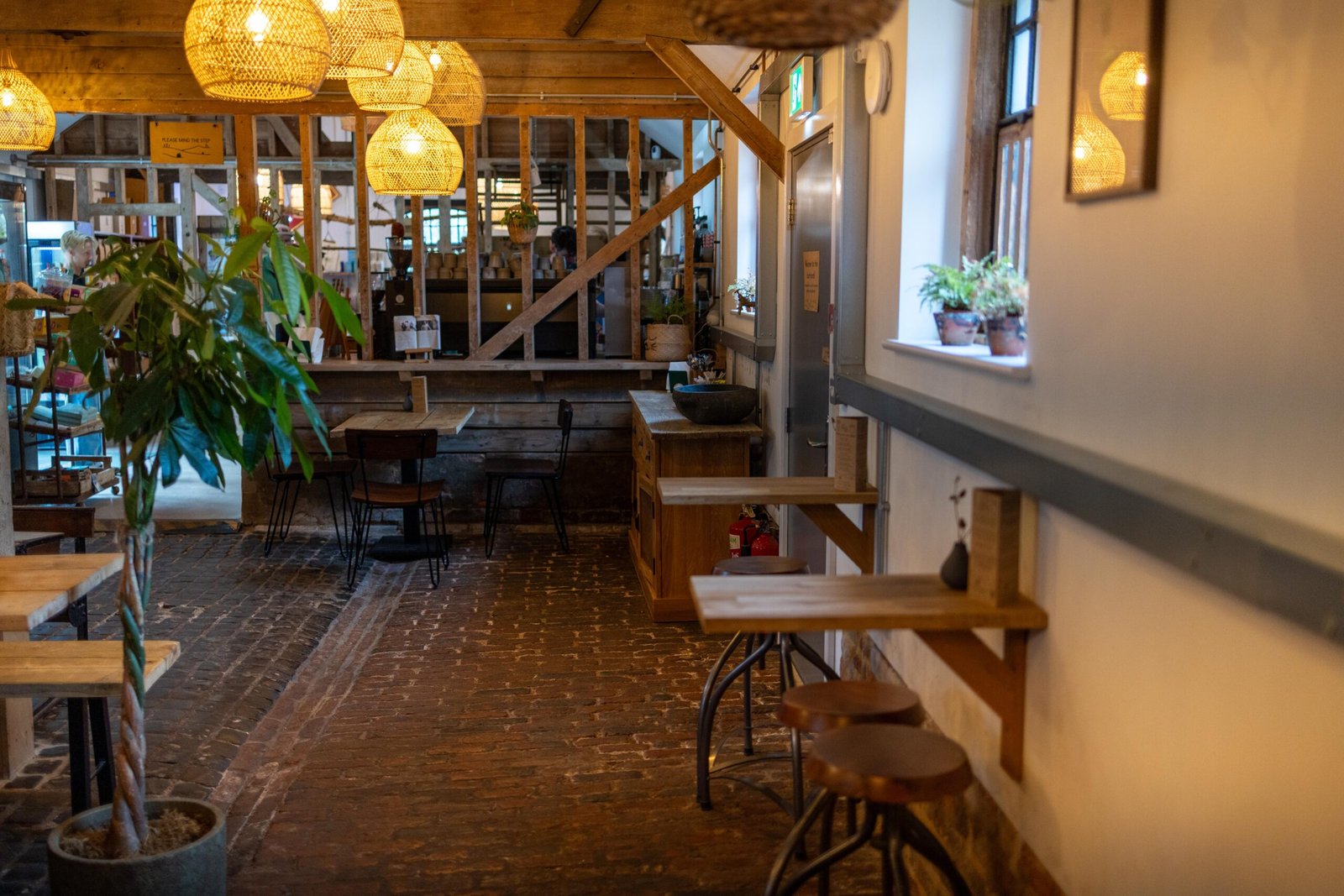
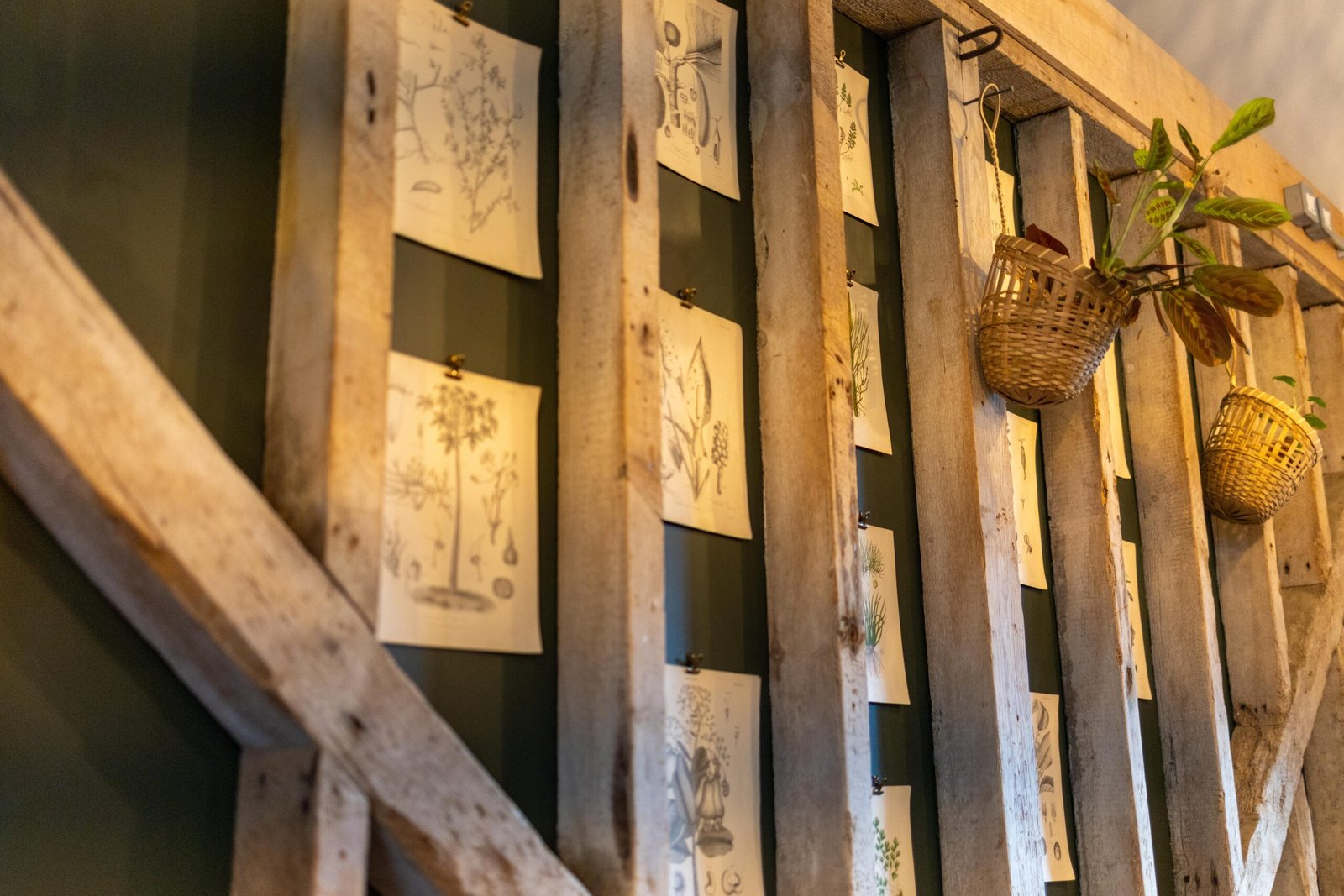
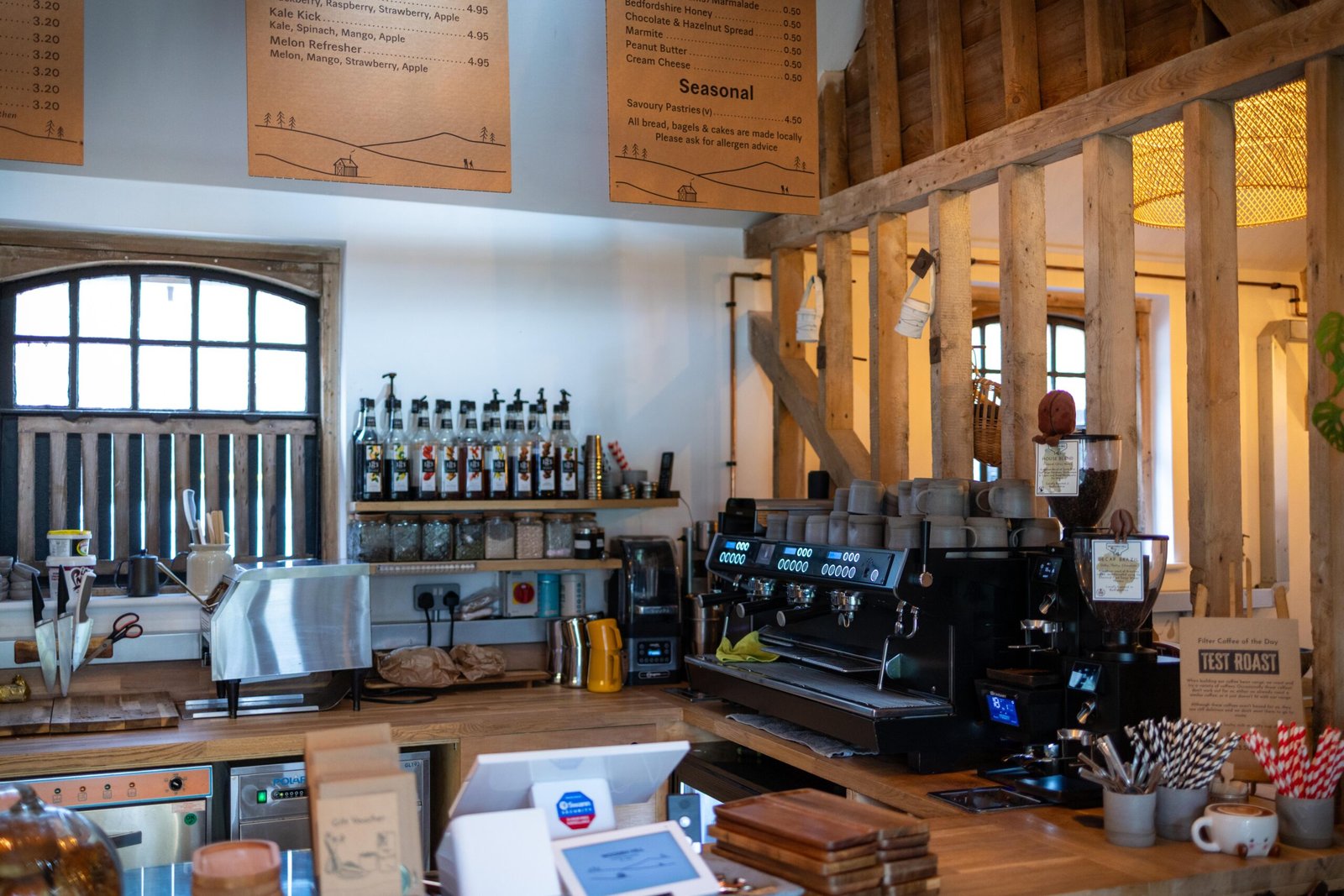
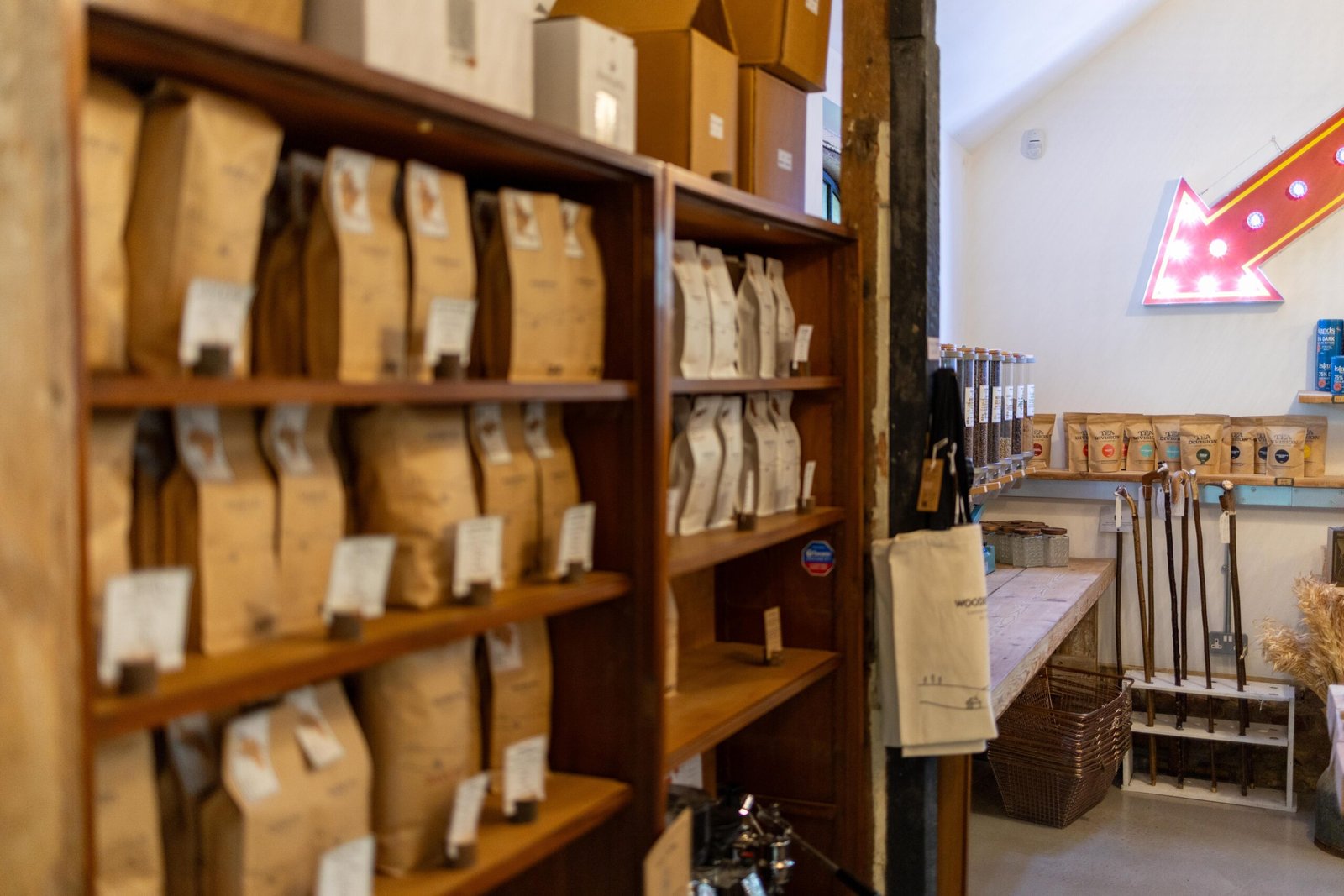
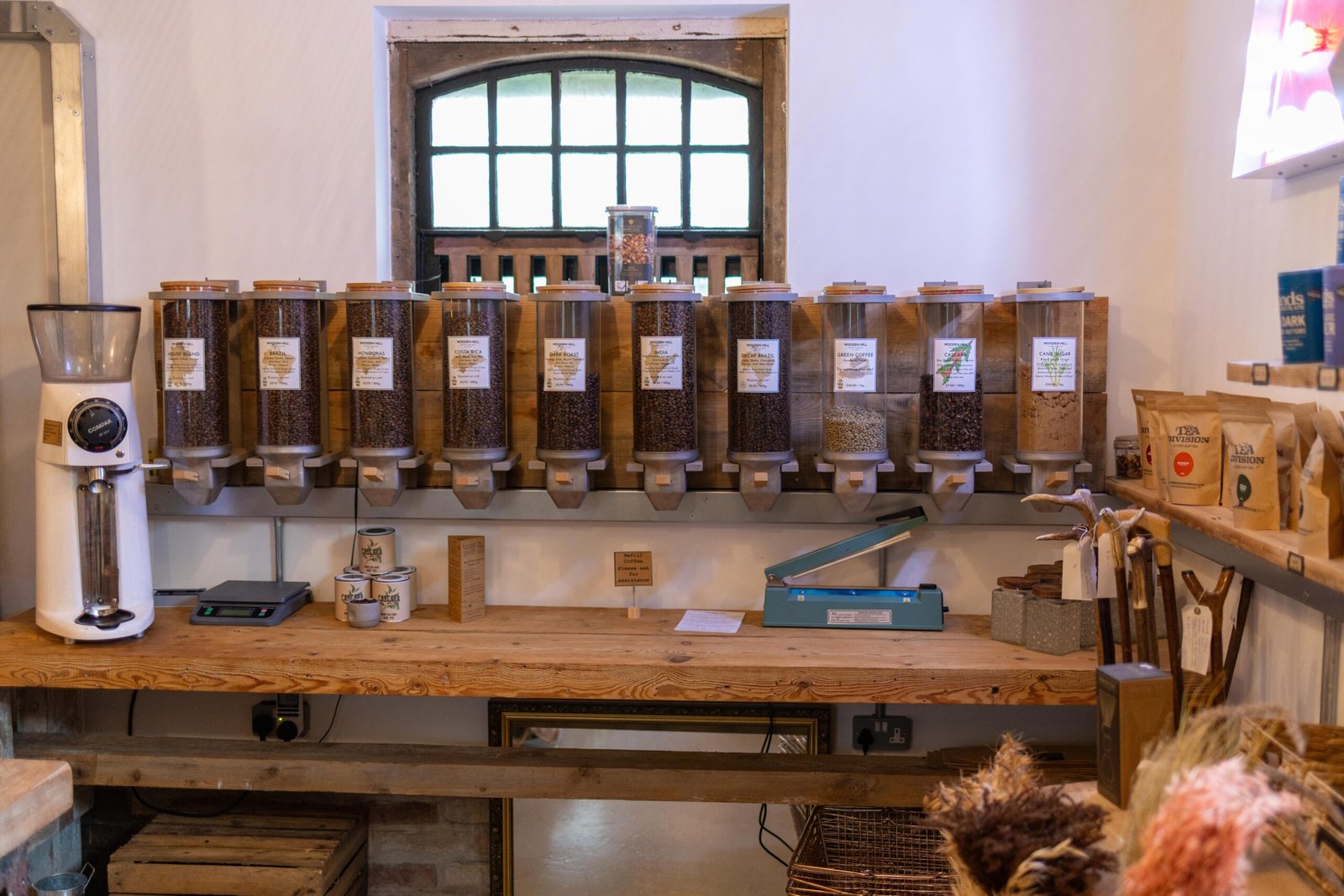
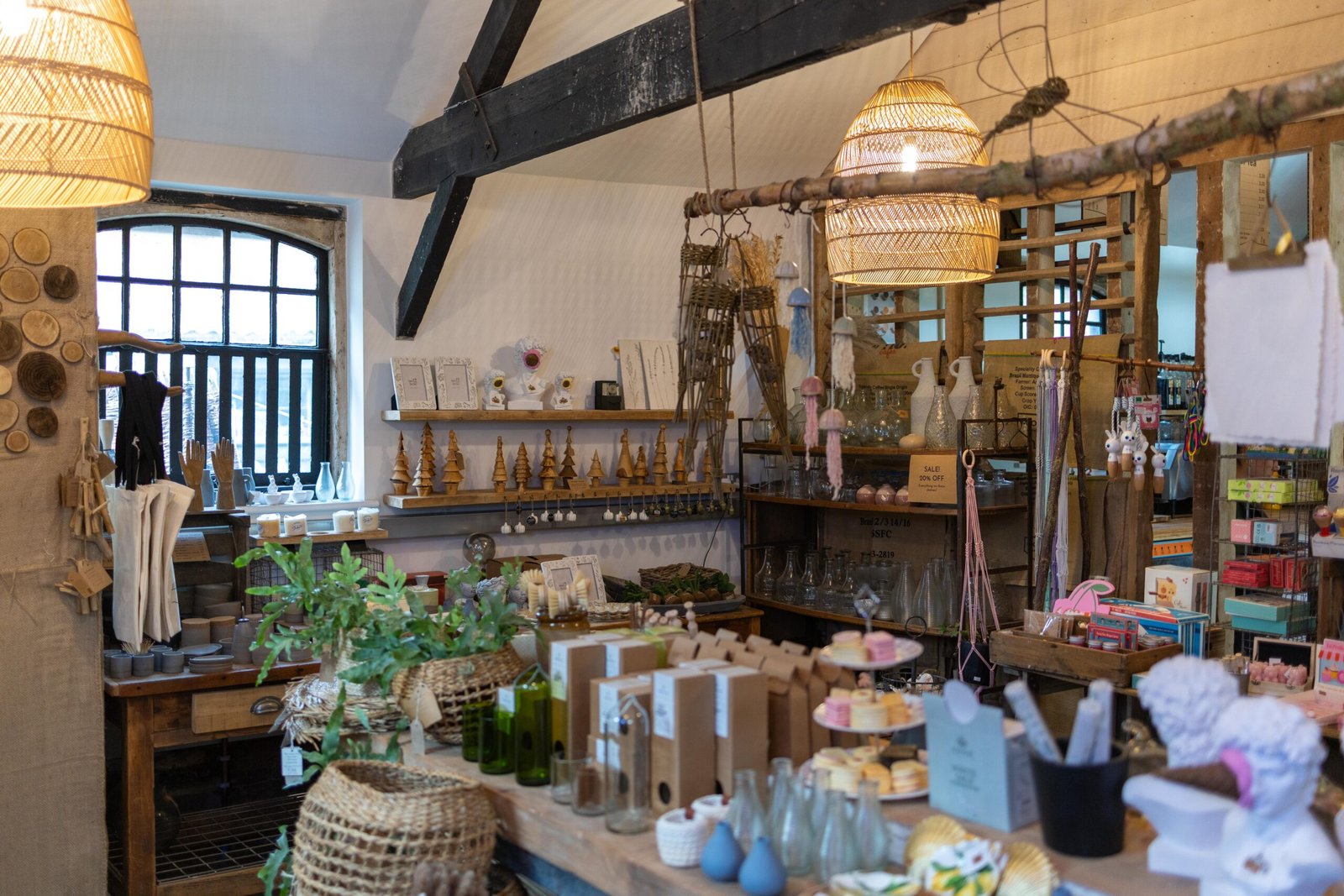
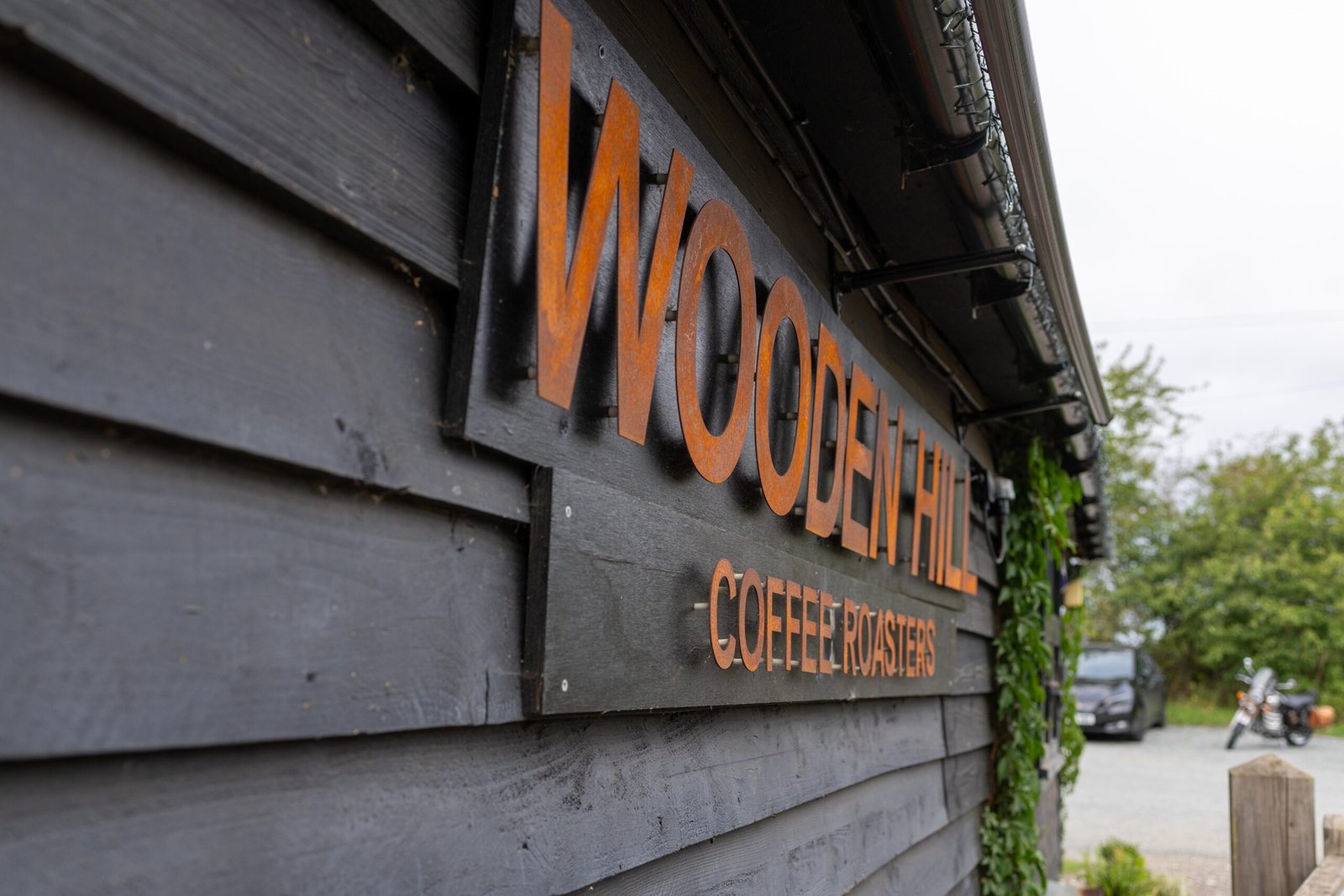
Wooden Hill Coffee Roastery and Cafe Haynes opened in November 2025. Robin got the keys in August of the same year and went to work creating the site while keeping the original features and making use of any recycled materials. For example, the furniture comes from Somerset House where it was refurbished. “The counter came from Wood St Bakery in London,” he said.
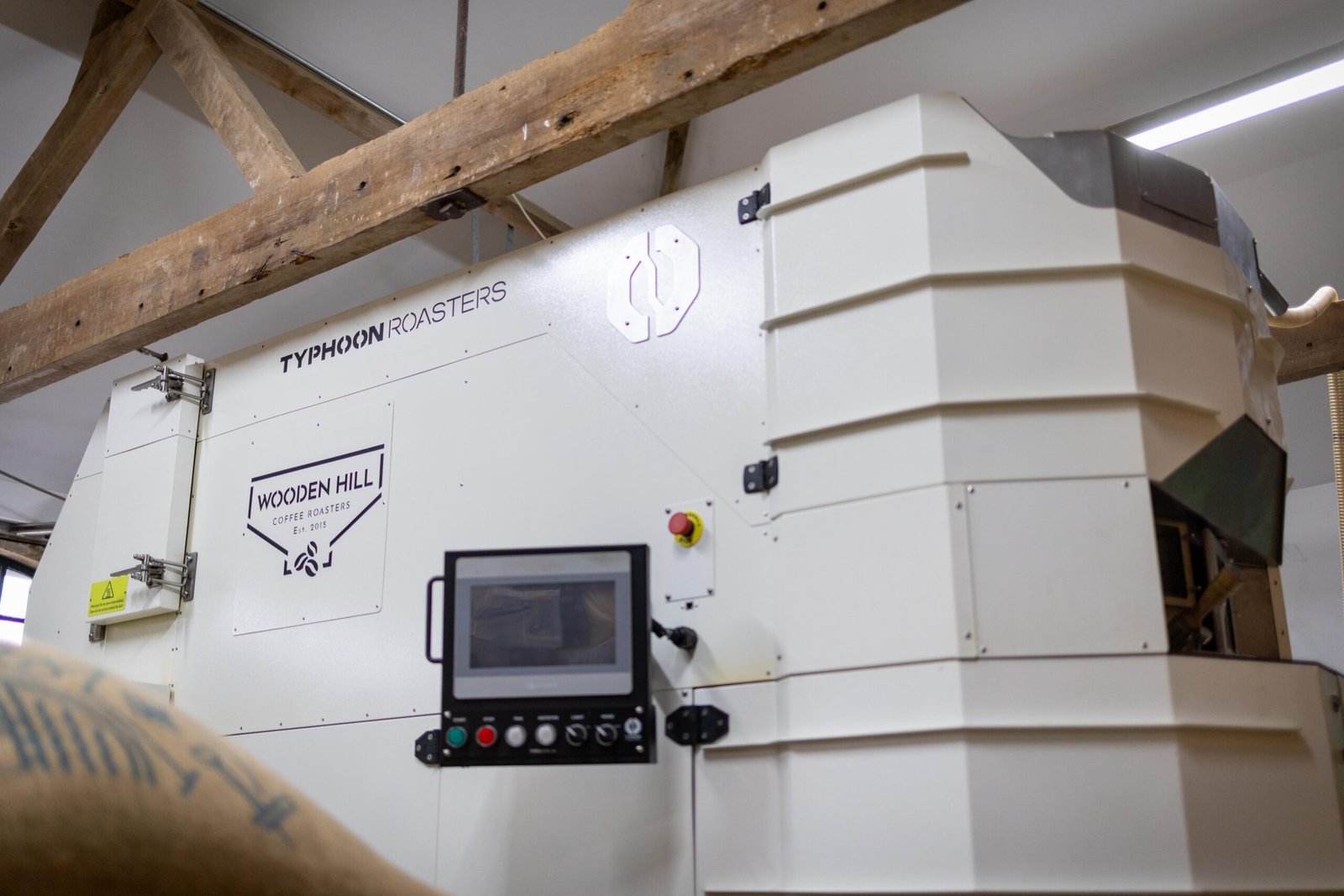
The approach to sustainability, not surprisingly, wasn’t an afterthought here either. “We’ve got 82 solar panels on the roof, going a long way to powering the barn,” Robin said. Inside, the cafe was fitted with a 20 kilo Typhoon electric roaster which is “far more efficient than the old gas ones,” he said. It also means that they can roast far more than they ever could.
With the operation successfully transferred over to Haynes, Millbrook closed in June of this year, marking the end of one chapter and the beginning of another.
Transforming the Bait Shed
Earlier this year, an opportunity arrived through an old contact: a fishing lake complex in Maulden, with a disused bait shed sitting empty.
Robin and a friend took on the conversion themselves. They salvaged windows that were destined for a skip, repurposed what materials they could, and built out the interior by hand. The new site opened just before summer, its launch coinciding almost accidentally with a spell of hot weather.
Robin later took me on a walk to the adjacent building, the club house, which is being completely transformed. A roaster will be fitted and there will be seating inside with the works expected to be complete prior to Christmas. It’s another exciting development in the Wooden Hill story.
What’s Next
At 51, Robin talks about the future carefully. “If you make your job your hobby, you never do another day’s work,” he said, recalling a piece of advice from a friend that has stayed with him for years. Retirement, at least in the traditional sense, holds little appeal. “I like going to work. Sometimes I come in when I don’t have to, because I want to.”
Ask Robin to sum up how he built the business and he quickly pushes back on the idea that it was down to luck. Finding the current site meant knocking on doors that would never appear on a commercial property listing. On one occasion, a landowner came out to ask, quite reasonably, what he was doing wandering around their property.
“That’s not luck,” Robin said. “That’s me going out of my comfort zone.” People often tell him he was fortunate to find what he’s built. Robin sees it differently. “I worked hard to make that happen.”
After more than a decade of building Wooden Hill, from hand-stamped bags and van deliveries to a handmade cafe beside a fishing lake in Maulden and a thriving shop and roastery in Haynes, he still views success not as something that happened to him, but something earned through persistence, curiosity and a willingness to keep knocking on doors until one finally opened.
Wooden Hill Coffee Maulden | Water End, Maulden, MK45 2BD | Open daily, 8:30am–4pm | Motorcycle parking: free just outside | Instagram: @wooden_hill_coffee_roasters
Wooden Hill Coffee Haynes | Summerfield Barns, Hammerhill, Haynes MK45 3BH | Open daily, 8:30am–4pm | Motorcycle parking: free just outside | Instagram: @woodenhill_haynes