
Nobody tells you that the hardest part isn’t the drinking. It’s the evenings. The ones that used to disappear into a couple of pints without you noticing, and now just sit there, wide open, waiting for you to work out what to do with them. Seven years in, I’ve mostly figured that part out. But in year one? Year one was just a lot of very long evenings.
Then it’s the special occasions. Birthdays, weddings, holidays, the ones that come round once and matter, where you don’t get a quiet trial run first. Until you’ve been through each of them individually at least once, you’re still working things out with something close to military precision: how you’re going to act, how you’re going to cope, how you’re still going to have a good time without being the odd one out. Nobody warns you that sobriety isn’t one thing to adjust to, it’s a whole calendar of them, each with its own version of the same problem to solve.
As an aside, Clare Pooley does a brilliant job of capturing exactly that first year in her book The Sober Diaries. It’s got real humour to it and reads easily, and it’s a good reminder that working your way through a whole calendar of firsts is a genuinely universal part of early sobriety, not just something you’re clumsily figuring out alone.
My reasons for quitting were rooted in something I’d been reading at the time: This Naked Mind by Annie Grace. It doesn’t tell a story so much as take apart the beliefs propping up why we drink in the first place: that alcohol relaxes us, sharpens social situations, makes celebrations feel like celebrations. Reading it, I understood none of that was actually true. It’s mostly conditioning, and once you see that clearly, the craving loosens its grip on its own rather than needing to be white-knuckled away.
What actually surprised me was how easy it turned out to be to still have a good time. Genuinely. Alcohol was great at loosening me up early on, and terrible at keeping me fun for the rest of the night. Without it, I was more present. I was actually around for the conversations, having the kind of exchanges that turn into real connections rather than just noise. And the best part: I could remember all of it the next day.
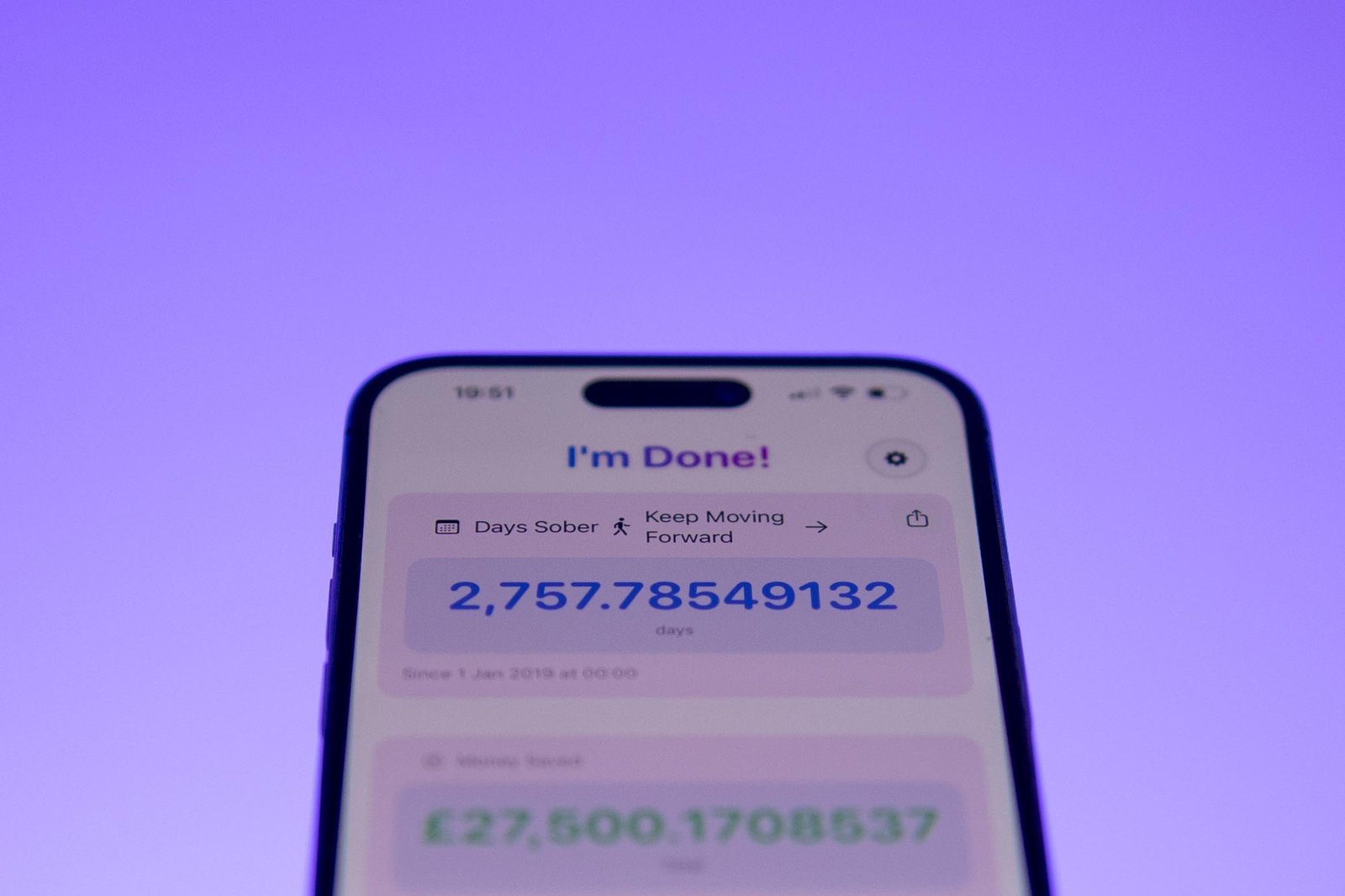
Speaking of surprises, money never crossed my mind either. It wasn’t why I stopped, so I never thought to add it up. But I downloaded an app called I’m Done! on the 1st of January 2019, my first day alcohol-free, and it’s been tracking things in the background ever since. I checked it recently: just over £27k saved, and 2.6 million calories avoided, based on the 967 I used to pour into my body every single day. Staggering numbers, both of them.
I’d read that relationships can shift once you stop drinking, that you can even lose people over it. That never really happened to me, which was probably the more surprising bit. The inevitable questions came up early on, the odd bit of curiosity or concern, but only one person ever said anything that stung: something along the lines of “you’ll be back drinking again soon.” I didn’t take it personally. If the roles had been reversed, it’s probably something I’d have said myself.
Because quitting had been a conscious choice rather than something forced on me, I was completely comfortable carrying on socialising much as before: same pub, same group, just a sparkling water or an alcohol-free beer in hand instead. Nothing else really had to change.
Pixar does this thing sometimes: a character’s entire world falling apart on the inside, shown from just far enough away that nothing on the outside looks wrong at all. That was basically my first year. No one around me had any idea just how monumental quitting really was. They’d seen me have a bit much, sure, but I was careful never to be seen drinking more than anyone else. I got good at knowing when to leave before things tipped into embarrassment, though not always good enough: once I left a work event in London, passed out on the train, and woke up in Bedford at 1am with no service back to St Albans for over an hour. So the milestones I was quietly celebrating that first year, I knew exactly how significant they were, but I couldn’t really say so without admitting how far down the rabbit hole I’d actually gone. I can write about it now. I couldn’t have in year one.
Year one and year seven aren’t really the same experience wearing a different number. In year one, the whole thing was active. Every evening was a small decision, every occasion needed a plan, every situation had a strategy sitting quietly in the background just in case. Somewhere around year three, I noticed I’d stopped checking the I’m Done! app religiously, stopped needing quit lit to remind myself why I was doing this. I was just going to things. No strategy required.
What’s changed more than anything is how I see other people drinking. When I see someone properly intoxicated now, my first thought, probably a selfish one, is that could so easily still be me. And underneath that, real gratitude that I don’t have to deal with that side of myself anymore.
Last year I went to a wedding with some old work colleagues, people I’ve had some big nights out with back in the day. It was effortless. Just a great time, plain and simple, the kind that used to require some thought and this time just didn’t, because there was nothing left to think about.
None of this is really about the drinking, not anymore. It’s why I still get up at 4am for a ride, why a flask of coffee at the top of a hill means something, why a long solo ride home doesn’t need to be filled with anything except the road. Seven years on, sobriety isn’t the story. It’s just the ground everything else gets to happen on.